Ch. 3 - Cell Structure and Function
Bauman - Microbiology with Diseases by Taxonomy 6th Edition
Bauman6th EditionMicrobiology with Diseases by TaxonomyISBN: 9780134832302Not the one you use?Change textbook
Chapter 3, Problem 15

Dipicolinic acid is an important component of __________ .


a. Gram-positive archaeal walls
b. cytoplasmic membranes in eukaryotes
c. endospores
d. Golgi bodies

Verified step by step guidance
1
Understand what dipicolinic acid is: it is a chemical compound known to be associated with certain bacterial structures.
Recall that dipicolinic acid is primarily found in bacterial endospores, where it plays a crucial role in heat resistance and stability.
Review the options given: Gram-positive archaeal walls, cytoplasmic membranes in eukaryotes, endospores, and Golgi bodies.
Eliminate options that do not relate to bacterial structures or known locations of dipicolinic acid, such as cytoplasmic membranes in eukaryotes and Golgi bodies.
Conclude that dipicolinic acid is an important component of endospores, which are specialized, resistant structures formed by some bacteria.

Verified video answer for a similar problem:

This video solution was recommended by our tutors as helpful for the problem above.
Video duration:
1m
Was this helpful?

Key Concepts

Here are the essential concepts you must grasp in order to answer the question correctly.

Dipicolinic Acid

Dipicolinic acid is a unique chemical compound found predominantly in bacterial endospores. It plays a crucial role in spore resistance by stabilizing proteins and DNA, and helps in dehydration of the spore core, contributing to heat resistance.
Recommended video:

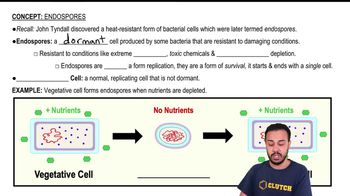
Endospores

Endospores are highly resistant, dormant structures formed by certain bacteria, such as Bacillus and Clostridium species, to survive extreme environmental conditions. They contain dipicolinic acid, which is essential for their durability and resistance to heat, radiation, and chemicals.
Recommended video:

Cellular Structures in Microorganisms

Different microorganisms have distinct cellular components, such as Gram-positive archaeal walls, cytoplasmic membranes, and organelles like Golgi bodies in eukaryotes. Understanding these structures helps differentiate where specific molecules like dipicolinic acid are found.
Recommended video:
Guided course
01:25
Importance of Microorganisms