Insertions and deletions in the genetic code are also called ___________ mutations.
Ch. 7 - Microbial Genetics
Bauman6th EditionMicrobiology with Diseases by TaxonomyISBN: 9780134832302Not the one you use?Change textbook
Chapter 7, Problem 4
Which of the following forms ionic bonds with eukaryotic DNA and stabilizes it?
a. Chromatin
b. Bacteriocin
c. Histone
d. Nucleoid
Verified step by step guidance1
Understand the nature of the question: It asks which molecule forms ionic bonds with eukaryotic DNA to stabilize it. This involves knowledge of DNA structure and associated proteins in eukaryotic cells.
Recall that eukaryotic DNA is wrapped around proteins to form a complex called chromatin, which helps in packaging and stabilizing DNA within the nucleus.
Identify the key proteins involved in chromatin structure: Histones are positively charged proteins that bind to the negatively charged phosphate backbone of DNA through ionic bonds.
Evaluate the options: Chromatin is the complex of DNA and proteins, bacteriocins are antibacterial proteins, histones are the DNA-binding proteins, and nucleoid refers to the DNA region in prokaryotes.
Conclude that the molecule forming ionic bonds with eukaryotic DNA to stabilize it is the histone protein.

Verified video answer for a similar problem:
This video solution was recommended by our tutors as helpful for the problem above.
Video duration:
1mWas this helpful?
Key Concepts
Here are the essential concepts you must grasp in order to answer the question correctly.
Histones and DNA Interaction
Histones are positively charged proteins that bind to the negatively charged phosphate backbone of eukaryotic DNA through ionic bonds. This interaction helps package DNA into a compact, stable structure called chromatin, facilitating gene regulation and protection.
Recommended video:
Guided course
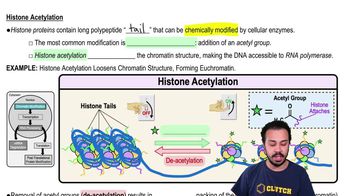
Histone Acetylation
Chromatin Structure
Chromatin is the complex of DNA and proteins, mainly histones, found in the nucleus of eukaryotic cells. It organizes DNA into nucleosomes, allowing efficient packaging and playing a key role in controlling gene expression and DNA stability.
Recommended video:
Guided course
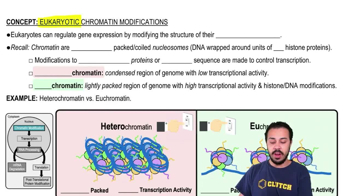
Eukaryotic Chromatin Modifications
Differences Between Eukaryotic and Prokaryotic DNA Organization
Eukaryotic DNA is wrapped around histones forming chromatin, whereas prokaryotic DNA is organized in a nucleoid without histones. Understanding this distinction is crucial to identify which molecules stabilize DNA in different organisms.
Recommended video:
Guided course
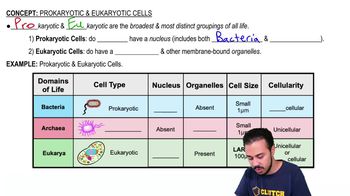
Prokaryotic & Eukaryotic Cells
Related Practice
Textbook Question
4
views
Textbook Question
Nucleotides used in the replication of DNA __________ .
a. Carry energy
b. Are found in four forms, each with a deoxyribose sugar, a phosphate, and a base
c. Are present in cells as triphosphate nucleotides
d. All of the above are correct.
Textbook Question
Polypeptide synthesis requires large amounts of energy. How do cells regulate synthesis to conserve energy? Describe one specific example.
2
views
Textbook Question
Compare and contrast introns and exons.
1
views
Textbook Question
Three effects of point mutations are ___________ , ___________ , and ____________ .
1
views
Textbook Question
A plasmid is __________ .
a. a molecule of RNA found in bacterial cells
b. distinguished from a chromosome by being circular
c. a structure in bacterial cells formed from plasma membrane
d. extrachromosomal DNA
1
views