
Starch is readily metabolized by many cells, but a starch molecule is too large to cross the plasma membrane. How does a cell obtain the glucose molecules from a starch polymer? How does the cell transport these glucose molecules across the plasma membrane?

Tortora 14th Edition
Ch. 4 - Functional Anatomy of Prokaryotic and Eukaryotic Cells
Problem 7Which of the following pairs is mismatched?
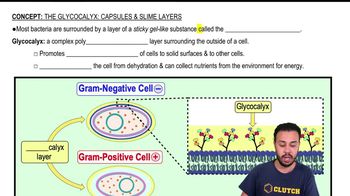
a. Glycocalyx—adherence
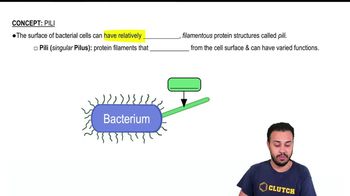
b. Pili—reproduction
c. Cell wall—toxin
d. Cell wall—protection
e. Plasma membrane—transport
Verified step by step guidance
Verified video answer for a similar problem:
Key Concepts
Glycocalyx and Adherence
Pili and Reproduction
Cell Wall Functions
Which of the following is false about fimbriae?
a. They are composed of protein.
b. They may be used for attachment.
c. They are found on gram-negative cells.
d. They are composed of pilin.
e. They may be used for motility.
Compare and contrast the following:
a. Simple diffusion and facilitated diffusion
b. Active transport and facilitated diffusion
c. Active transport and group translocation
Answer the following questions using the diagrams provided, which represent cross sections of bacterial cell walls.
a. Which diagram represents a gram-positive bacterium? How can you tell?
b. Explain how the Gram stain works to distinguish these two types of cell walls.
c. Why does penicillin have no effect on most gram-negative cells?
d. How do essential molecules enter cells through each wall?
e. Which cell wall is toxic to humans?
Match the characteristics of eukaryotic cells in column A with their functions in column B.
Which of the following pairs is mismatched?
a. Metachromatic granules—stored phosphates
b. Polysaccharide granules—stored starch
c. Lipid inclusions—poly-β-hydroxybutyric acid
d. Sulfur granules—energy reserve
e. Ribosomes—protein storage