Ch. 26 - Applied and Industrial Microbiology
Bauman - Microbiology with Diseases by Taxonomy 6th Edition
Bauman6th EditionMicrobiology with Diseases by TaxonomyISBN: 9780134832302Not the one you use?Change textbook
Chapter 26, Problem 3

Indicate whether the following statement is true or false. Rewrite the underlined phrase to make a false statement true.
_______Pasteurization kills mesophilic microorganisms except endospore formers.

Verified step by step guidance
1
Step 1: Understand the definition of pasteurization. Pasteurization is a heat treatment process aimed at reducing the number of viable pathogenic microorganisms and spoilage organisms in food and beverages, typically by heating to a temperature below boiling for a specific time.
Step 2: Identify what mesophilic microorganisms are. Mesophiles are microorganisms that grow best at moderate temperatures, typically between 20°C and 45°C, and many are sensitive to heat treatments like pasteurization.
Step 3: Recognize the limitation of pasteurization regarding endospore formers. Endospores are highly resistant structures produced by some bacteria (e.g., Bacillus and Clostridium species) that can survive pasteurization because the process does not reach temperatures high enough to destroy spores.
Step 4: Analyze the statement: 'Pasteurization kills mesophilic microorganisms except endospore formers.' This is generally true because pasteurization effectively kills most vegetative mesophilic cells but not the heat-resistant endospores.
Step 5: To make the statement false, you could rewrite the underlined phrase to say that pasteurization kills all microorganisms including endospore formers, which is incorrect because pasteurization does not kill endospores.

Verified video answer for a similar problem:

This video solution was recommended by our tutors as helpful for the problem above.
Video duration:
2m
Was this helpful?

Key Concepts

Here are the essential concepts you must grasp in order to answer the question correctly.

Pasteurization

Pasteurization is a heat treatment process that reduces microbial load in food and beverages by killing most pathogenic and spoilage microorganisms, especially mesophilic bacteria, without significantly affecting taste or quality. It typically involves heating to temperatures below boiling, such as 63°C for 30 minutes or 72°C for 15 seconds.
Recommended video:
Guided course
03:53
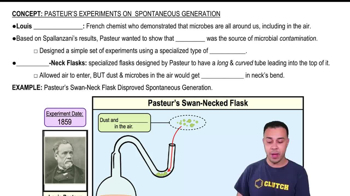
Pasteur's Experiments on Spontaneous Generation

Mesophilic Microorganisms

Mesophilic microorganisms thrive at moderate temperatures, usually between 20°C and 45°C. They include many bacteria responsible for food spoilage and some pathogens. Pasteurization targets these microbes to improve food safety and shelf life.
Recommended video:
Guided course
01:25
Importance of Microorganisms

Endospore Formers

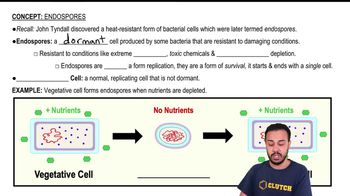
Endospore formers are bacteria capable of producing highly resistant spores that survive harsh conditions, including heat treatments like pasteurization. These spores can germinate later, making them more difficult to eliminate and a concern in food safety.
Recommended video: