Ch. 4 - Microscopy, Staining, and Classification
Bauman - Microbiology with Diseases by Taxonomy 6th Edition
Bauman6th EditionMicrobiology with Diseases by TaxonomyISBN: 9780134832302Not the one you use?Change textbook
Chapter 4, Problem 7

Which of the following types of microscopes produces a three- dimensional image with a shadowed appearance?
a. Simple microscope
b. Differential interference contrast microscope
c. Fluorescence microscope
d. Transmission electron microscope

Verified step by step guidance
1
Understand the characteristics of each microscope type listed in the options.
Recall that a simple microscope uses a single lens and produces a two-dimensional image, so it does not create a three-dimensional shadowed appearance.
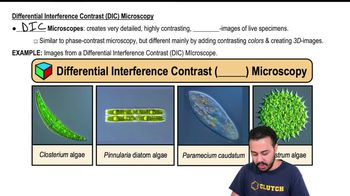
Know that a differential interference contrast (DIC) microscope enhances contrast in unstained, transparent samples by using polarized light, producing images with a three-dimensional, shadowed effect.
Recognize that a fluorescence microscope uses fluorescent dyes and light to produce bright images of specific structures, but these images are typically two-dimensional and do not have a shadowed, 3D appearance.
Understand that a transmission electron microscope (TEM) produces highly detailed two-dimensional images by transmitting electrons through thin specimens, not three-dimensional shadowed images.

Verified video answer for a similar problem:

This video solution was recommended by our tutors as helpful for the problem above.
Video duration:
2m
Was this helpful?

Key Concepts

Here are the essential concepts you must grasp in order to answer the question correctly.

Differential Interference Contrast (DIC) Microscopy

DIC microscopy enhances contrast in unstained, transparent samples by using polarized light and optical modifications to produce images with a three-dimensional, shadowed appearance. This technique highlights differences in refractive index, making cellular structures appear with depth and texture.
Recommended video:
Guided course
02:03
Differential Interference Contrast (DIC) Microscopy

Types of Microscopes and Their Imaging Techniques

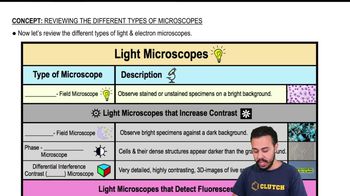
Microscopes vary in how they generate images: simple microscopes use a single lens, fluorescence microscopes detect emitted light from fluorescent tags, and transmission electron microscopes (TEM) use electron beams to produce high-resolution 2D images. Understanding these differences helps identify which microscope produces 3D shadowed images.
Recommended video:
Guided course
05:32
Reviewing the Different Types of Microscopes

Three-Dimensional Imaging in Microscopy

3D imaging in microscopy refers to techniques that provide depth perception and spatial information about the sample. Methods like DIC and confocal microscopy create images with apparent depth, unlike traditional 2D imaging, allowing better visualization of surface structures and morphology.
Recommended video:
Guided course
03:46
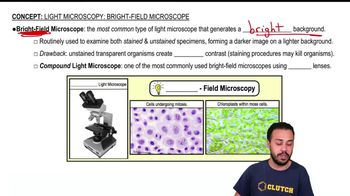
Light Microscopy: Bright-Field Microscopes