Ch. 27 - Environmental Microbiology
Tortora - Microbiology: An Introduction 14th Edition
Tortora14th EditionMicrobiology: An IntroductionISBN: 9780138200398Not the one you use?Change textbook
Chapter 27, Problem 6

The following organisms have important roles as symbionts with plants and fungi; describe the symbiotic relationship of each organism with its host: cyanobacteria, mycorrhizae, Rhizobium, Frankia.

Verified step by step guidance
1
Identify the type of symbiotic relationship each organism has with its host, focusing on whether it is mutualistic, commensalistic, or parasitic.
For cyanobacteria, explain their role in nitrogen fixation and how they form symbiotic associations with certain plants or fungi, benefiting both partners.
Describe mycorrhizae as a mutualistic association between fungi and plant roots, where fungi enhance nutrient and water uptake for the plant, and in return receive carbohydrates.
Explain the relationship of Rhizobium bacteria with leguminous plants, highlighting how Rhizobium fixes atmospheric nitrogen into a form usable by the plant within root nodules.
Discuss Frankia bacteria and their symbiotic relationship with actinorhizal plants, focusing on nitrogen fixation and the formation of root nodules similar to Rhizobium.

Verified video answer for a similar problem:

This video solution was recommended by our tutors as helpful for the problem above.
Video duration:
2m
Was this helpful?

Key Concepts

Here are the essential concepts you must grasp in order to answer the question correctly.

Symbiosis and Types of Symbiotic Relationships

Symbiosis refers to a close and long-term biological interaction between two different organisms. It can be mutualistic, where both partners benefit; commensalistic, where one benefits without harming the other; or parasitic, where one benefits at the expense of the other. Understanding these types helps clarify how organisms like cyanobacteria, mycorrhizae, Rhizobium, and Frankia interact with their hosts.
Recommended video:
Guided course
05:59
Symbiotic Relationships

Nitrogen Fixation by Symbiotic Bacteria

Certain bacteria such as Rhizobium and Frankia form symbiotic relationships with plants by fixing atmospheric nitrogen into ammonia, a form usable by plants. This process enriches soil fertility and supports plant growth, especially in nitrogen-poor environments. Recognizing nitrogen fixation is key to understanding the ecological role of these symbionts.
Recommended video:
Guided course
05:59
Symbiotic Relationships

Mycorrhizal Associations and Nutrient Exchange

Mycorrhizae are symbiotic associations between fungi and plant roots that enhance nutrient and water uptake for the plant. In return, the fungus receives carbohydrates from the plant. This mutualistic relationship improves plant health and soil structure, illustrating the importance of fungal symbionts in ecosystems.
Recommended video:
Guided course
03:26
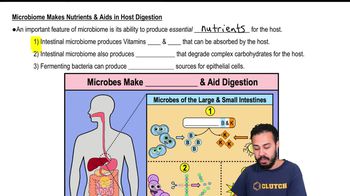
Microbiome Makes Nutrients & Aids in Host Digestion