Ch. 3 - Introduction to Prokaryotic Cells
Norman-McKay- Microbiology: Basic and Clinical Principles 2nd Edition
Norman-McKay2nd EditionMicrobiology: Basic and Clinical PrinciplesISBN: 9780137661619Not the one you use?Change textbook
Chapter 3, Problem 3

Select any of the following characteristics that would NOT apply to prokaryotes.
a. Generally simpler than eukaryotes
b. Multicellular
c. Lack a true nucleus
d. Tend to have a single circular chromosome
e. Often lack a cell wall
f. All make endospores
g. Divide by mitosis
h. Includes the Domain Archaea
i. Includes the Domain Bacteria
j. Includes the Domain Eukarya

Verified step by step guidance
1
Step 1: Understand the definition of prokaryotes. Prokaryotes are unicellular organisms that lack a true nucleus and membrane-bound organelles. They include organisms from the Domains Bacteria and Archaea.
Step 2: Evaluate each characteristic to see if it applies to prokaryotes. For example, prokaryotes are generally simpler than eukaryotes, so option (a) applies to prokaryotes.
Step 3: Identify characteristics that do NOT apply to prokaryotes. For instance, prokaryotes are unicellular, so (b) 'Multicellular' does NOT apply to prokaryotes.
Step 4: Consider cell division methods. Prokaryotes divide by binary fission, not mitosis, so (g) 'Divide by mitosis' does NOT apply to prokaryotes.
Step 5: Review domain classifications. Prokaryotes include Domains Bacteria and Archaea, so (j) 'Includes the Domain Eukarya' does NOT apply to prokaryotes.

Verified video answer for a similar problem:

This video solution was recommended by our tutors as helpful for the problem above.
Video duration:
2m
Was this helpful?

Key Concepts

Here are the essential concepts you must grasp in order to answer the question correctly.

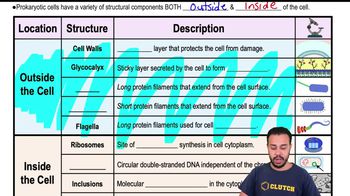
Prokaryotic Cell Structure

Prokaryotes are unicellular organisms that lack a true nucleus and membrane-bound organelles. Their genetic material is typically a single circular chromosome located in the nucleoid region. This simpler cell structure distinguishes them from eukaryotes.
Recommended video:
Guided course
05:59
Overview of Prokaryotic Cell Structure

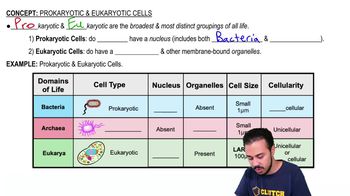
Differences Between Prokaryotes and Eukaryotes

Prokaryotes differ from eukaryotes in several ways: they are generally unicellular, do not undergo mitosis, and often have cell walls. Eukaryotes are usually multicellular, have a true nucleus, and divide by mitosis, which is absent in prokaryotes.
Recommended video:
Guided course
05:54
Prokaryotic & Eukaryotic Cells

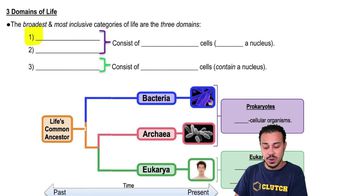
Classification of Domains

The domains Bacteria and Archaea consist of prokaryotic organisms, while Eukarya includes all eukaryotes. Understanding these domains helps identify which characteristics apply to prokaryotes and which belong to eukaryotes.
Recommended video:
Guided course
05:20
3 Domains of Life