Ch. 5 - Microbial Metabolism
Tortora - Microbiology: An Introduction 14th Edition
Tortora14th EditionMicrobiology: An IntroductionISBN: 9780138200398Not the one you use?Change textbook
Chapter 5, Problem 10

Use the following choices to answer the question.
a. E. coli growing in glucose broth at 35℃ with O2 for 5 days
b. E. coli growing in glucose broth at 35℃ without O2 for 5 days
c. Both a and b
d. Neither a nor b


Which culture uses the most glucose?

Verified step by step guidance
1
Step 1: Understand the metabolic capabilities of E. coli. E. coli is a facultative anaerobe, meaning it can grow in the presence or absence of oxygen by switching between aerobic respiration and fermentation or anaerobic respiration.
Step 2: Recognize that aerobic respiration (with O₂) is more efficient in energy production per glucose molecule than anaerobic metabolism (without O₂). This means E. coli growing with oxygen will generate more ATP per glucose molecule.
Step 3: Consider that because aerobic respiration is more efficient, E. coli growing with oxygen will consume less glucose to meet its energy needs compared to anaerobic growth, which requires more glucose to produce the same amount of energy.
Step 4: Analyze the conditions given: (a) E. coli with oxygen and (b) E. coli without oxygen, both grown for the same time and temperature. The culture without oxygen will likely use more glucose overall to sustain growth.
Step 5: Conclude that the culture growing without oxygen (anaerobic) uses the most glucose because it relies on less efficient metabolic pathways that consume more glucose to produce energy.

Verified video answer for a similar problem:

This video solution was recommended by our tutors as helpful for the problem above.
Video duration:
2m
Was this helpful?

Key Concepts

Here are the essential concepts you must grasp in order to answer the question correctly.

Metabolic Pathways in E. coli

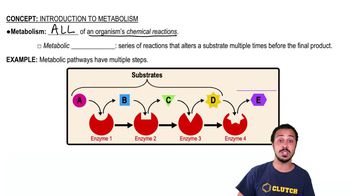
E. coli can metabolize glucose using aerobic respiration when oxygen is present, producing more energy per glucose molecule. Without oxygen, it switches to anaerobic fermentation, which yields less energy and different byproducts. Understanding these pathways helps explain differences in glucose consumption.
Recommended video:
Guided course
02:17
Introduction to Metabolism

Effect of Oxygen on Glucose Utilization

Oxygen availability influences how efficiently E. coli uses glucose. In aerobic conditions, glucose is fully oxidized to CO₂ and water, maximizing energy extraction and glucose consumption. Under anaerobic conditions, glucose is partially broken down, resulting in less energy and potentially less glucose used.
Recommended video:
Guided course
01:32
Effects of the Complement System

Growth Conditions and Duration Impact on Metabolism

The temperature, duration, and oxygen presence affect bacterial growth rate and metabolism. At 35℃ for 5 days, E. coli will metabolize glucose differently depending on oxygen, impacting total glucose usage. Longer growth allows more glucose consumption, but metabolic efficiency varies with conditions.
Recommended video:
Guided course
02:17
Introduction to Metabolism