
Ch. 3 - Cell Structure and Function
Bauman - Microbiology with Diseases by Taxonomy 6th Edition
Bauman6th EditionMicrobiology with Diseases by TaxonomyISBN: 9780134832302Not the one you use?Change textbook
Chapter 3, Problem 1

A cell may allow a large or charged chemical to move across the cytoplasmic membrane, down the chemical’s electrical and chemical gradients, in a process called _________ .                   .


a. active transport
b. facilitated diffusion
c. endocytosis
d. pinocytosis

Verified step by step guidance
1
Step 1: Understand the key terms in the question. The question describes a process where a large or charged chemical moves across the cytoplasmic membrane down its electrical and chemical gradients. This means the movement is passive, not requiring energy input from the cell.
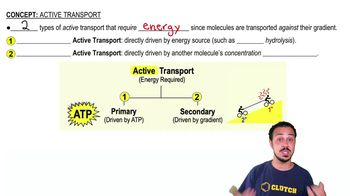
Step 2: Recall that active transport requires energy (usually ATP) to move substances against their gradients, so option (a) active transport is unlikely here because the movement is down the gradients.
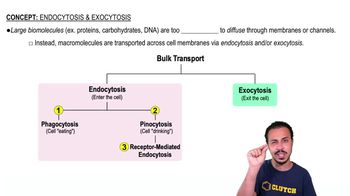
Step 3: Consider endocytosis and pinocytosis (options c and d), which involve the cell engulfing substances by forming vesicles. These processes are not typically described as movement down gradients across the membrane but rather internalization of substances.
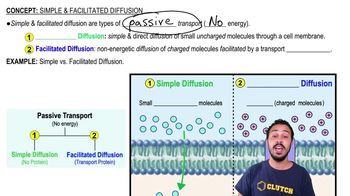
Step 4: Facilitated diffusion (option b) is a passive transport mechanism where proteins help large or charged molecules cross the membrane down their concentration or electrical gradients without energy expenditure.
Step 5: Based on the definitions and the description, the correct term to fill in the blank is the process that allows passive movement of large or charged molecules with the help of membrane proteins, which is facilitated diffusion.

Verified video answer for a similar problem:

This video solution was recommended by our tutors as helpful for the problem above.
Video duration:
4m
Was this helpful?

Key Concepts

Here are the essential concepts you must grasp in order to answer the question correctly.

Facilitated Diffusion

Facilitated diffusion is a passive transport process where specific carrier proteins or channels help large or charged molecules cross the cell membrane down their concentration gradient, without using cellular energy. It allows substances that cannot diffuse freely through the lipid bilayer to enter or exit the cell efficiently.
Recommended video:
Guided course
05:10
Simple and Facilitated Diffusion

Active Transport

Active transport involves moving molecules against their concentration or electrical gradients using energy, usually from ATP. This process requires specific transport proteins and is essential for accumulating substances inside the cell or expelling waste, unlike passive processes that rely on gradients.
Recommended video:
Guided course
02:37
Active Transport

Endocytosis and Pinocytosis

Endocytosis is a cellular process where the membrane engulfs extracellular material to bring it into the cell, often forming vesicles. Pinocytosis is a type of endocytosis specifically for the uptake of fluids and dissolved substances. Both require energy and are distinct from passive transport mechanisms.
Recommended video:
Guided course
02:02
Endocytosis and Exocytosis
Related Practice
Textbook Question

Match the terms with their descriptions following. Only one description is intended for each term.


 ____ Ribosome

 ____ Cytoskeleton

 ____ Centriole

 ____ Nucleus

 ____ Mitochondrion

 ____ Chloroplast

 ____ ER

 ____ Golgi body

 ____ Peroxisome


A. Site of protein synthesis

B. Contains enzymes to neutralize hydrogen peroxide

C. Functions as the transport system within a eukaryotic cell

D. Allows contraction of the cell

E. Site of most DNA in eukaryotes

F. Contains microtubules in "9 + 0" arrangement

G. Light-harvesting organelle

H. Packages large molecules for export from a cell

I. Its internal membranes are sites for ATP production

1
views
Textbook Question

Sketch, name, and describe three flagellar arrangements in bacteria.

3
views
Textbook Question

Label the structures of the following prokaryotic and eukaryotic cells. With a single word or short phrase, explain the function of each structure.

a.

b.

c.

d.

e.

f.

g.

h.

i.

j.

k.

l.

m.

n.

o.

p.

q.

1
views
Textbook Question

Describe (or draw) an example of diffusion down a concentration gradient.

1
views
Textbook Question

Match the structures with their descriptions following. A letter may be used more than once or not at all, and more than one letter may be correct for each blank.


  ____ Glycocalyx

  ____ Flagella

  ____ Axial filaments

 ____ Cilia

  ____ Fimbriae

  ____ Pili

  ____ Hami


A. Bristlelike projections found in quantities of 100 or more

B. Long whip

C. Responsible for conjugation

D. “Sweet cup” composed of polysaccharides and/or polypeptides

E. Numerous “grappling-hook” projections

F. Responsible for motility of spirochetes

G. Extensions not used for cell motility

H. Made of tubulin in eukaryotes

I. Made of flagellin in bacteria

6
views