Ch. 2 - Biochemistry Basics
Norman-McKay- Microbiology: Basic and Clinical Principles 2nd Edition
Norman-McKay2nd EditionMicrobiology: Basic and Clinical PrinciplesISBN: 9780137661619Not the one you use?Change textbook
Chapter 2, Problem 17

a. b. c. d. Label the following reactions as a neutralization reaction, a hydrolysis reaction, or a dehydration synthesis reaction. <IMAGE>

Verified step by step guidance
1
Step 1: Understand the definitions of the three types of reactions: Neutralization reactions involve an acid and a base reacting to form water and a salt; Hydrolysis reactions involve breaking a bond in a molecule using water; Dehydration synthesis reactions involve joining two molecules together with the removal of water.
Step 2: Examine each reaction carefully and identify the reactants and products. Look for the presence or absence of water being consumed or produced, and whether bonds are being formed or broken.
Step 3: For each reaction, determine if water is being added to break a bond (hydrolysis), removed to form a bond (dehydration synthesis), or if an acid-base reaction is occurring producing water and salt (neutralization).
Step 4: Label each reaction accordingly based on your analysis: if water is consumed to split molecules, label it hydrolysis; if water is produced when molecules combine, label it dehydration synthesis; if an acid and base react to form water and salt, label it neutralization.
Step 5: Review your labels to ensure consistency with the chemical changes observed in each reaction, confirming that the classification matches the reaction mechanism.

Verified video answer for a similar problem:

This video solution was recommended by our tutors as helpful for the problem above.
Video duration:
1m
Was this helpful?

Key Concepts

Here are the essential concepts you must grasp in order to answer the question correctly.

Neutralization Reaction

A neutralization reaction occurs when an acid and a base react to form water and a salt, effectively canceling out each other's properties. This reaction typically involves the transfer of protons (H+) and results in a solution with a neutral pH.
Recommended video:
Guided course
01:56
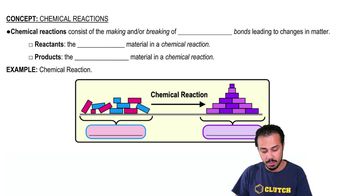
Chemical Reactions

Hydrolysis Reaction

Hydrolysis is a chemical process where a molecule is split into two parts by the addition of a water molecule. It is commonly involved in breaking down complex molecules like polymers into monomers, such as breaking down proteins into amino acids.
Recommended video:
Guided course
01:56
Chemical Reactions

Dehydration Synthesis Reaction

Dehydration synthesis, or condensation reaction, involves joining two molecules by removing a water molecule. This reaction is essential for forming larger biomolecules like carbohydrates, proteins, and lipids from their smaller subunits.
Recommended video:
Guided course
01:56
Chemical Reactions