A pastry chef accidentally inoculated a cream pie with six S. aureus cells. If S. aureus has a generation time of 60 minutes, how many cells would be in the cream pie after 7 hours?
Ch. 6 - Microbial Growth

Tortora14th EditionMicrobiology: An IntroductionISBN: 9780138200398Not the one you use?Change textbook
Chapter 6, Problem 5
Assume you inoculated 100 facultatively anaerobic cells onto nutrient agar and incubated the plate aerobically. You then inoculated 100 cells of the same species onto nutrient agar and incubated the second plate anaerobically. After incubation for 24 hours, you should have
a. more colonies on the aerobic plate.
b. more colonies on the anaerobic plate.
c. the same number of colonies on both plates.
Verified step by step guidance1
Understand the definition of facultatively anaerobic bacteria: these bacteria can grow in both the presence and absence of oxygen by switching their metabolic pathways accordingly.
Recognize that since the species is facultatively anaerobic, it can grow under both aerobic (with oxygen) and anaerobic (without oxygen) conditions.
Consider that you inoculated the same number of cells (100) on both plates, so the initial number of viable cells is equal.
Since facultative anaerobes can grow in both conditions, the number of colonies formed after incubation should be similar on both plates, assuming all other growth conditions are equal.
Therefore, the expected outcome is that the number of colonies on the aerobic plate and the anaerobic plate will be the same.

Verified video answer for a similar problem:
This video solution was recommended by our tutors as helpful for the problem above.
Video duration:
2mWas this helpful?
Key Concepts
Here are the essential concepts you must grasp in order to answer the question correctly.
Facultative Anaerobes
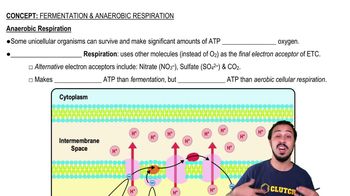
Facultative anaerobes are microorganisms that can grow in both the presence and absence of oxygen. They prefer oxygen for aerobic respiration because it generates more energy but can switch to anaerobic metabolism when oxygen is unavailable, allowing them to survive and grow under both conditions.
Recommended video:
Guided course
Anaerobic Respiration
Nutrient Agar and Colony Formation
Nutrient agar is a general-purpose medium that supports the growth of many bacteria. When cells are inoculated onto agar and incubated, each viable cell can form a visible colony. The number of colonies reflects the number of cells that survived and multiplied under the given conditions.
Recommended video:
Guided course
Formation & Breakdown of Polysaccharides
Effect of Oxygen on Growth of Facultative Anaerobes
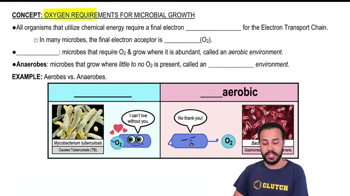
Oxygen availability influences the growth rate of facultative anaerobes. They typically grow faster and form more colonies aerobically due to efficient aerobic respiration. Under anaerobic conditions, growth may be slower or less robust, potentially resulting in fewer colonies after the same incubation period.
Recommended video:
Guided course
Oxygen Requirements for Microbial Growth
Related Practice
Textbook Question
1
views
Textbook Question
Which of the lines best depicts the log phase of Listeria monocytogenes growing in a human?
6
views
Textbook Question
Seven methods of measuring microbial growth were explained in this chapter. Categorize each as either a direct or an indirect method.
2
views
Textbook Question
By deep-freezing, bacteria can be stored without harm for extended periods. Why do refrigeration and freezing preserve foods?
1
views
Textbook Question
Which of the lines best depicts the log phase of a thermophile incubated at room temperature?
4
views
Textbook Question
The term trace elements refers to
a. The elements CHONPS.
b. Vitamins.
c. Nitrogen, phosphorus, and sulfur.
d. Small mineral requirements.
e. Toxic substances.
1
views