Ch. 7 - The Control of Microbial Growth
Tortora - Microbiology: An Introduction 14th Edition
Tortora14th EditionMicrobiology: An IntroductionISBN: 9780138200398Not the one you use?Change textbook
Chapter 7, Problem 1

The thermal death time for a suspension of Bacillus subtilis endospores is in dry heat and less than in an autoclave. Which type of heat is more effective? Why?

Verified step by step guidance
1
Understand the concept of thermal death time (TDT), which is the time required to kill a specific microorganism at a given temperature.
Recognize that dry heat and moist heat (such as in an autoclave) differ in their mechanisms of killing microorganisms: dry heat kills primarily by oxidation, while moist heat kills by coagulating proteins.
Recall that moist heat is generally more effective at lower temperatures and shorter times because it penetrates cells better and denatures proteins more efficiently.
Compare the thermal death times given: since the TDT is less in an autoclave (moist heat) than in dry heat, it indicates that moist heat is more effective at killing Bacillus subtilis endospores.
Conclude that moist heat (autoclaving) is more effective because it causes protein denaturation and coagulation more rapidly, leading to faster microbial death compared to dry heat.

Verified video answer for a similar problem:

This video solution was recommended by our tutors as helpful for the problem above.
Video duration:
2m
Was this helpful?

Key Concepts

Here are the essential concepts you must grasp in order to answer the question correctly.

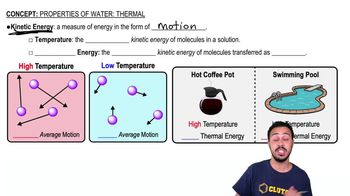
Thermal Death Time

Thermal death time is the minimum time required to kill a specific microorganism at a given temperature. It helps determine how long heat must be applied to ensure complete sterilization, especially for resistant forms like endospores.
Recommended video:
Guided course
04:07
Properties of Water- Thermal

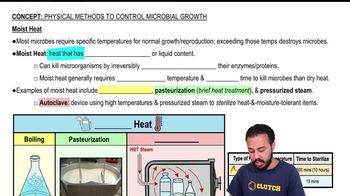
Dry Heat vs. Moist Heat Sterilization

Dry heat sterilization uses hot air and kills microbes by oxidation, requiring higher temperatures and longer times. Moist heat, such as autoclaving, uses steam under pressure, which penetrates cells better and denatures proteins more efficiently, making it generally more effective.
Recommended video:

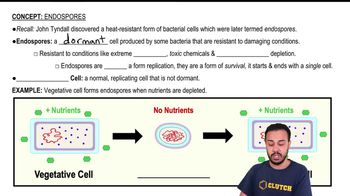
Endospore Resistance

Endospores are highly resistant dormant forms of bacteria like Bacillus subtilis. Their tough outer layers protect them from heat and chemicals, but moist heat can penetrate and destroy them faster than dry heat due to better heat transfer and protein coagulation.
Recommended video: