Ch. 8 - Microbial Metabolism
Norman-McKay- Microbiology: Basic and Clinical Principles 2nd Edition
Norman-McKay2nd EditionMicrobiology: Basic and Clinical PrinciplesISBN: 9780137661619Not the one you use?Change textbook
Chapter 8, Problem 11

_______________________ is a process that uses energy from nutrients to fuel an electron transport chain to make ATP.

Verified step by step guidance
1
Identify the key components of the process described: it uses energy from nutrients, involves an electron transport chain, and results in the production of ATP.
Recall that the process which uses energy derived from nutrients to drive an electron transport chain for ATP synthesis is a fundamental metabolic pathway in cells.
Understand that this process involves transferring electrons through a series of membrane-bound proteins, creating a proton gradient that powers ATP synthase to generate ATP.
Recognize that this process is commonly known as 'cellular respiration' or more specifically 'oxidative phosphorylation' when referring to the electron transport chain and ATP synthesis step.
Conclude that the blank should be filled with the term describing this energy-conserving process, which is 'cellular respiration' or 'oxidative phosphorylation'.

Verified video answer for a similar problem:

This video solution was recommended by our tutors as helpful for the problem above.
Video duration:
4m
Was this helpful?

Key Concepts

Here are the essential concepts you must grasp in order to answer the question correctly.

Cellular Respiration

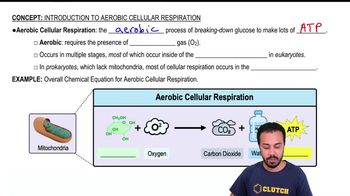
Cellular respiration is the metabolic process by which cells convert nutrients, especially glucose, into usable energy in the form of ATP. It involves glycolysis, the Krebs cycle, and an electron transport chain, where energy from electrons is harnessed to produce ATP.
Recommended video:
Guided course
05:11
Introduction to Aerobic Cellular Respiration

Electron Transport Chain (ETC)

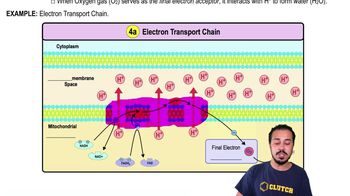
The electron transport chain is a series of protein complexes located in the cell membrane (or mitochondrial membrane in eukaryotes) that transfer electrons from electron donors to acceptors. This transfer releases energy used to pump protons and create a gradient that drives ATP synthesis.
Recommended video:
Guided course
07:41
Electron Transport Chain

ATP Synthesis

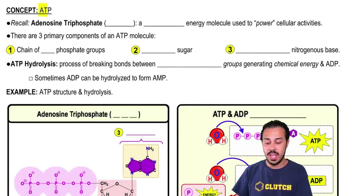
ATP synthesis is the process of producing adenosine triphosphate (ATP), the cell’s main energy currency. In the electron transport chain, the proton gradient generated powers ATP synthase, an enzyme that synthesizes ATP from ADP and inorganic phosphate, providing energy for cellular activities.
Recommended video:
Related Practice
Textbook Question

Why do human cells require oxygen? Select all relevant statements.

a. To carry out glycolysis

b. To carry out fermentation

c. To carry out cellular respiration

d. To oxidize fats

e. To carry out substrate-level phosphorylation

f. To carry out oxidative phosphorylation

g. To carry out photophosphorylation

1
views
Textbook Question

The photo shows an organism growing in glucose fermentation broth. What can you conclude about this specimen with regard to its ability (or lack thereof) to ferment the sugar sucrose? Explain your answer.

<IMAGE>

1
views
Textbook Question

_______________________ is a process that uses light energy to drive an electron transport chain to make ATP.

2
views
Textbook Question

The _______________________ test detects if an organism can convert hydrogen peroxide to water and oxygen. The test result is usually _______________________ in anaerobic microbes and usually _______________________ in aerobic microbes. You know the test is positive by _______________________.

1
views
Textbook Question

_______________________ is a process that relies on a phosphorylated intermediate to directly convert ADP to ATP.

Textbook Question

Use this pathway schematic to answer questions a through d.

a. Which enzyme carries out a redox reaction? In this reaction, what is being reduced and what is being oxidized?

b. Which enzyme would be the most likely to be regulated by feedback inhibition?

c. What is the end product of this pathway?

d. Which enzyme carries out substrate-level phosphorylation?