Ch. 7 - Microbial Genetics
Bauman - Microbiology with Diseases by Taxonomy 6th Edition
Bauman6th EditionMicrobiology with Diseases by TaxonomyISBN: 9780134832302Not the one you use?Change textbook
Chapter 7, Problem 8

Describe the formation and function of mRNA, rRNA, and tRNA in prokaryotes and eukaryotes.

Verified step by step guidance
1
Start by defining each type of RNA: mRNA (messenger RNA), rRNA (ribosomal RNA), and tRNA (transfer RNA), highlighting their roles in protein synthesis.
Explain the formation of mRNA in both prokaryotes and eukaryotes, focusing on transcription from DNA, noting that in prokaryotes mRNA is often polycistronic and in eukaryotes it undergoes processing such as 5' capping, splicing, and 3' polyadenylation.
Describe the synthesis of rRNA, emphasizing that it is transcribed from rDNA genes in the nucleolus in eukaryotes and in the nucleoid region in prokaryotes, and explain its role as a structural and catalytic component of ribosomes.
Outline the formation of tRNA, including transcription from tRNA genes, and mention the post-transcriptional modifications that occur, as well as its function in delivering specific amino acids to the ribosome during translation.
Summarize the functional differences and similarities of these RNAs in prokaryotes and eukaryotes, emphasizing how they collaborate to ensure accurate and efficient protein synthesis.

Verified video answer for a similar problem:

This video solution was recommended by our tutors as helpful for the problem above.
Video duration:
3m
Was this helpful?

Key Concepts

Here are the essential concepts you must grasp in order to answer the question correctly.

Types of RNA: mRNA, rRNA, and tRNA

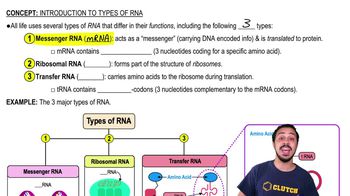
mRNA (messenger RNA) carries genetic information from DNA to ribosomes for protein synthesis. rRNA (ribosomal RNA) forms the core of ribosome structure and catalyzes protein assembly. tRNA (transfer RNA) transports specific amino acids to the ribosome during translation, matching codons on mRNA with the correct amino acid.
Recommended video:
Guided course
07:20
Introduction to Types of RNA

RNA Formation (Transcription) in Prokaryotes and Eukaryotes

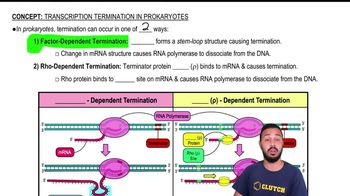
Transcription is the process of synthesizing RNA from a DNA template. In prokaryotes, transcription occurs in the cytoplasm and produces mRNA that is often polycistronic. In eukaryotes, transcription occurs in the nucleus, producing pre-mRNA that undergoes processing like splicing, 5' capping, and polyadenylation before becoming mature mRNA.
Recommended video:
Guided course
04:17
Transcription Termination in Prokaryotes

Function and Processing Differences Between Prokaryotic and Eukaryotic RNA

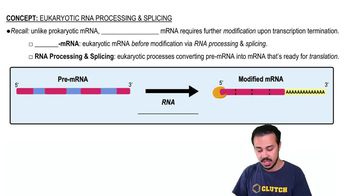
In prokaryotes, mRNA is typically short-lived and directly translated, while eukaryotic mRNA is processed and transported out of the nucleus. rRNA and tRNA are transcribed by different RNA polymerases in eukaryotes and undergo extensive modification. These differences affect how RNA functions in protein synthesis across the two domains.
Recommended video:
Guided course
02:32
Eukaryotic RNA Processing and Splicing