Ch. 25 - Pathogenic RNA Viruses
Bauman - Microbiology with Diseases by Taxonomy 6th Edition
Bauman6th EditionMicrobiology with Diseases by TaxonomyISBN: 9780134832302Not the one you use?Change textbook
Chapter 25, Problem 1

Label the steps in retroviral replication shown for HIV.
<IMAGE>

Verified step by step guidance
1
Identify the initial step where the HIV virus attaches to the host cell by binding its envelope glycoproteins to the CD4 receptor and a co-receptor on the host cell surface. This is called viral attachment and entry.
Next, recognize the fusion of the viral envelope with the host cell membrane, allowing the viral capsid to enter the cytoplasm. This step is viral fusion and uncoating.
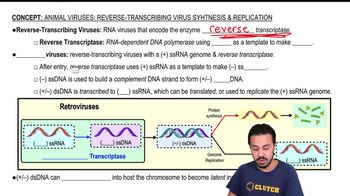
Then, focus on the reverse transcription process where the viral RNA genome is converted into double-stranded DNA by the enzyme reverse transcriptase carried within the virus.
After reverse transcription, the newly synthesized viral DNA is transported into the host cell nucleus and integrated into the host genome by the viral enzyme integrase. This step is called integration.
Finally, understand that the integrated viral DNA (provirus) is transcribed and translated by the host machinery to produce new viral RNA genomes and proteins, which assemble into new virions that bud from the host cell to infect other cells.

Verified video answer for a similar problem:

This video solution was recommended by our tutors as helpful for the problem above.
Video duration:
1m
Was this helpful?

Key Concepts

Here are the essential concepts you must grasp in order to answer the question correctly.

Retroviral Genome and Entry

Retroviruses like HIV carry their genetic material as RNA. Upon infecting a host cell, the virus binds to specific receptors and fuses with the cell membrane, allowing the viral RNA to enter the cytoplasm. Understanding this initial step is crucial for tracing the replication process.
Recommended video:
Guided course
03:18
Genome Variability

Reverse Transcription

Once inside the host cell, HIV uses the enzyme reverse transcriptase to convert its single-stranded RNA genome into double-stranded DNA. This step is unique to retroviruses and is essential for integrating viral DNA into the host genome.
Recommended video:
Guided course
04:28
Animal Viruses: Reverse-Transcribing Virus Synthesis & Replication

Integration and Viral Assembly

The newly synthesized viral DNA is transported into the nucleus and integrated into the host's genome by the integrase enzyme. The host machinery then transcribes and translates viral proteins, which assemble into new virions that bud off to infect other cells.
Recommended video:
Guided course
05:12
Persistent Viral Infections