
Textbook Question
Which of the following compounds has the greatest amount of energy for a cell?
a. CO2
b. ATP
c. glucose
d. O2
e. lactic acid
1
views

 Verified step by step guidance
 04:36
04:36
 03:42
03:42 03:00
03:00Which of the following compounds has the greatest amount of energy for a cell?
a. CO2
b. ATP
c. glucose
d. O2
e. lactic acid
An enzyme and substrate are combined. The rate of reaction begins as shown in the following graph. To complete the graph, show the effect of increasing substrate concentration on a constant enzyme concentration. Show the effect of increasing temperature.
Which of the following reactions produces the most molecules of ATP during aerobic metabolism?
a. Glucose → Glucose 6-phosphate
b. Phosphoenolpyruvic acid → Pyruvic acid
c. Glucose → Pyruvic acid
d. Acetyl CoA → CO2 + H2O
e. Succinic acid → Fumaric acid
Define oxidation-reduction, and differentiate the following terms:
a. Aerobic and anaerobic respiration
b. Respiration and fermentation
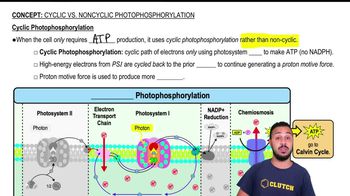
c. Cyclic and noncyclic photophosphorylation
Using the following diagrams, show each of the following:
a. where the substrate will bind
b. where the competitive inhibitor will bind
c. where the noncompetitive inhibitor will bind
d. which of the four elements could be the inhibitor in feedback inhibition
e. What effect will the reactions in (a), (b), and (c) have?
Use the following diagrams (a), (b), and (c) for the question.
<IMAGE>
Name pathways diagrammed in parts (a), (b), and (c) of the figure.
a. Show where glycerol is catabolized and where fatty acids are catabolized.
b. Show where glutamic acid (an amino acid) is catabolized:
<IMAGE>
c. Show how these pathways are related.
d. Where is ATP required in pathways (a) and (b)?
e. Where is CO₂ released in pathways (b) and (c)?
f. Show where a long-chain hydrocarbon such as petroleum is catabolized.
g. Where is NADH (or FADH₂ or NADPH) used and produced in these pathways?
h. Identify four places where anabolic and catabolic pathways are integrated.