Ch. 13 - Viruses, Viroids, and Prions
Tortora - Microbiology: An Introduction 14th Edition
Tortora14th EditionMicrobiology: An IntroductionISBN: 9780138200398Not the one you use?Change textbook
Chapter 13, Problem 1

Place the following in the most likely order for biosynthesis of a bacteriophage: (1) phage lysozyme; (2) mRNA; (3) DNA; (4) viral proteins; (5) DNA polymerase.
a. 5, 4, 3, 2, 1
b. 1, 2, 3, 4, 5
c. 5, 3, 4, 2, 1
d. 3, 5, 2, 4, 1
e. 2, 5, 3, 4, 1

Verified step by step guidance
1
Step 1: Understand the process of bacteriophage biosynthesis, which generally follows the central dogma of molecular biology: DNA replication, transcription to mRNA, and translation to proteins.
Step 2: Identify that DNA polymerase (5) is required first to replicate the phage DNA (3), so DNA polymerase must be synthesized or activated before DNA replication.
Step 3: After DNA replication, the phage DNA (3) is transcribed into mRNA (2), which serves as the template for protein synthesis.
Step 4: Viral proteins (4), including structural proteins and enzymes like phage lysozyme (1), are then synthesized from the mRNA.
Step 5: Finally, phage lysozyme (1) is produced to help lyse the bacterial cell and release new phage particles.

Verified video answer for a similar problem:

This video solution was recommended by our tutors as helpful for the problem above.
Video duration:
4m
Was this helpful?

Key Concepts

Here are the essential concepts you must grasp in order to answer the question correctly.

Central Dogma of Molecular Biology

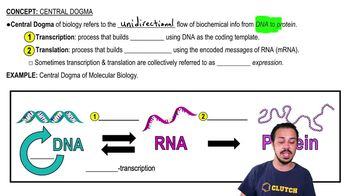
The central dogma describes the flow of genetic information from DNA to RNA to protein. DNA is first transcribed into mRNA, which is then translated into proteins. Understanding this sequence is essential to determine the order of biosynthesis steps in viral replication.
Recommended video:
Guided course
05:45
Central Dogma

Role of DNA Polymerase in Viral Replication

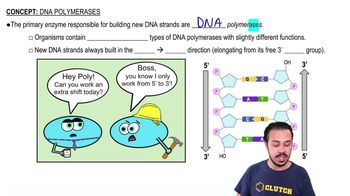
DNA polymerase is an enzyme that synthesizes new DNA strands from a DNA template. In bacteriophage biosynthesis, DNA polymerase replicates the viral genome before transcription and translation of viral proteins can occur.
Recommended video:
Guided course
04:01
DNA Polymerases

Function of Phage Lysozyme

Phage lysozyme is an enzyme produced late in the infection cycle that degrades the bacterial cell wall, allowing newly formed phage particles to be released. It is synthesized after viral proteins and genome replication are complete.
Recommended video:
Guided course
06:04
Functional Groups