Ch. 8 - Recombinant DNA Technology
Bauman - Microbiology with Diseases by Taxonomy 6th Edition
Bauman6th EditionMicrobiology with Diseases by TaxonomyISBN: 9780134832302Not the one you use?Change textbook
Chapter 8, Problem 2

Indicate which of the following are true and which are false. Rewrite any false statements to make them true by changing the underlined words.
__________ Restriction enzymes act at specific nucleotide sequences within a double-stranded DNA molecule.

Verified step by step guidance
1
Identify the key concept in the statement: restriction enzymes and their action on DNA.
Recall that restriction enzymes, also known as restriction endonucleases, recognize specific nucleotide sequences in double-stranded DNA and cut at or near these sites.
Evaluate the statement: 'Restriction enzymes act at specific nucleotide sequences within a double-stranded DNA molecule.' This is a true statement because restriction enzymes do target specific sequences in double-stranded DNA.
Since the statement is true, no rewriting is necessary.
Summarize: The statement is true because restriction enzymes recognize and cleave specific sequences in double-stranded DNA, which is fundamental to their role in molecular biology.

Verified video answer for a similar problem:

This video solution was recommended by our tutors as helpful for the problem above.
Video duration:
2m
Was this helpful?

Key Concepts

Here are the essential concepts you must grasp in order to answer the question correctly.

Restriction Enzymes

Restriction enzymes, also known as restriction endonucleases, are proteins that recognize specific short DNA sequences and cut the DNA at or near these sites. They are essential tools in molecular biology for DNA cloning and analysis.
Recommended video:
Guided course
03:27
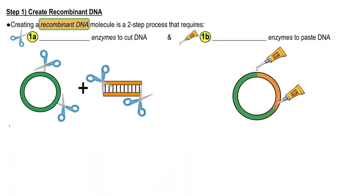
1a) Use Restriction Enzymes

Recognition Sites in DNA

Restriction enzymes target specific nucleotide sequences called recognition sites, which are usually palindromic and found within double-stranded DNA. These sites determine where the enzyme will cleave the DNA molecule.
Recommended video:
Guided course
04:24
Pattern Recognition Receptors

Double-Stranded DNA Structure

DNA is composed of two complementary strands forming a double helix. Restriction enzymes require this double-stranded structure to identify and cut at their specific recognition sequences accurately.
Recommended video:
Guided course
06:24
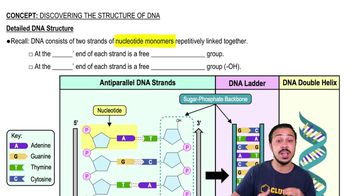
Detailed DNA Structure