Ch. 8 - Microbial Metabolism
Norman-McKay- Microbiology: Basic and Clinical Principles 2nd Edition
Norman-McKay2nd EditionMicrobiology: Basic and Clinical PrinciplesISBN: 9780137661619Not the one you use?Change textbook
Chapter 8, Problem 16

Rank the following from the most ATP that could be made to the least ATP that could be made:
a. 1 glucose molecule processed via a fermentation pathway (consider that glycolysis is the first stage of the process)
b. A lipid made of glycerol and three 10-carbon fatty acid chains entering cellular respiration
c. 1 glucose molecule entering the Entner–Doudoroff pathway
d. 1 glucose molecule entering cellular respiration

Verified step by step guidance
1
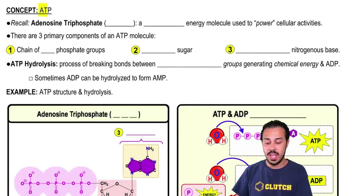
Step 1: Understand the ATP yield for each pathway or molecule. Recall that ATP is produced during glycolysis, the Krebs cycle, and the electron transport chain in cellular respiration, while fermentation yields much less ATP because it does not include the electron transport chain.
Step 2: For option (a), 1 glucose molecule processed via fermentation: Glycolysis produces 2 ATP per glucose, but fermentation itself does not produce additional ATP. So total ATP is from glycolysis only.
Step 3: For option (b), a lipid with glycerol and three 10-carbon fatty acid chains: Calculate ATP yield by considering that glycerol enters glycolysis as an intermediate, and each fatty acid undergoes beta-oxidation. Each 10-carbon fatty acid will produce multiple acetyl-CoA molecules, which enter the Krebs cycle, generating a significant amount of ATP.
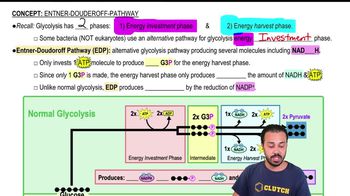
Step 4: For option (c), 1 glucose molecule entering the Entner–Doudoroff pathway: This pathway yields less ATP than glycolysis, typically 1 ATP per glucose, plus NADH and NADPH, so total ATP is lower than glycolysis plus full cellular respiration.
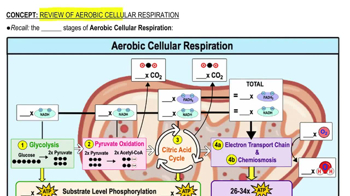
Step 5: For option (d), 1 glucose molecule entering full cellular respiration: This includes glycolysis, Krebs cycle, and electron transport chain, producing the maximum ATP yield per glucose molecule (approximately 30-32 ATP).

Verified video answer for a similar problem:

This video solution was recommended by our tutors as helpful for the problem above.
Video duration:
11m
Was this helpful?

Key Concepts

Here are the essential concepts you must grasp in order to answer the question correctly.

ATP Yield in Cellular Respiration

Cellular respiration breaks down glucose into carbon dioxide and water, producing ATP through glycolysis, the Krebs cycle, and oxidative phosphorylation. One glucose molecule fully processed can yield about 30-32 ATP molecules, making it the most efficient energy-producing pathway for glucose.
Recommended video:
Guided course
07:51
Review of Aerobic Cellular Respiration

Fermentation and ATP Production

Fermentation is an anaerobic process that allows glycolysis to continue by regenerating NAD+, but it produces much less ATP than aerobic respiration. Typically, fermentation yields only 2 ATP per glucose molecule, as it stops after glycolysis without further oxidation.
Recommended video:

Metabolism of Lipids and the Entner–Doudoroff Pathway

Lipids are broken down into glycerol and fatty acids; fatty acids undergo beta-oxidation producing acetyl-CoA, which enters the Krebs cycle, yielding more ATP than glucose. The Entner–Doudoroff pathway is an alternative glucose catabolism route producing less ATP (1 ATP per glucose) than glycolysis.
Recommended video:
Guided course
08:59
Entner-Doudoroff Pathway