Ch. 3 - Cell Structure and Function
Bauman - Microbiology with Diseases by Taxonomy 6th Edition
Bauman6th EditionMicrobiology with Diseases by TaxonomyISBN: 9780134832302Not the one you use?Change textbook
Chapter 3, Problem 15

Compare and contrast three types of passive transport across a cell membrane.

Verified step by step guidance
1
Identify the three main types of passive transport across a cell membrane: simple diffusion, facilitated diffusion, and osmosis.
Explain simple diffusion as the movement of small or nonpolar molecules directly through the phospholipid bilayer from an area of higher concentration to an area of lower concentration without the use of transport proteins.
Describe facilitated diffusion as the movement of molecules that cannot easily cross the membrane (such as ions or polar molecules) through specific transmembrane proteins like channel proteins or carrier proteins, still moving down their concentration gradient without energy input.
Define osmosis as the passive transport of water molecules across a selectively permeable membrane, moving from an area of lower solute concentration to an area of higher solute concentration to balance solute concentrations on both sides.
Compare the three by highlighting that all move substances down their concentration gradients without energy, but differ in the types of molecules transported and whether transport proteins are required.

Verified video answer for a similar problem:

This video solution was recommended by our tutors as helpful for the problem above.
Video duration:
2m
Was this helpful?

Key Concepts

Here are the essential concepts you must grasp in order to answer the question correctly.

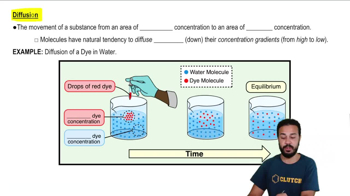
Diffusion

Diffusion is the passive movement of molecules from an area of higher concentration to lower concentration until equilibrium is reached. It does not require energy and typically involves small, nonpolar molecules like oxygen and carbon dioxide passing directly through the lipid bilayer.
Recommended video:

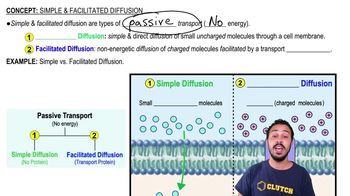
Facilitated Diffusion

Facilitated diffusion is the passive transport of molecules across the membrane via specific carrier or channel proteins. It allows larger or polar molecules, such as glucose or ions, to move down their concentration gradient without energy input.
Recommended video:
Guided course
05:10
Simple and Facilitated Diffusion

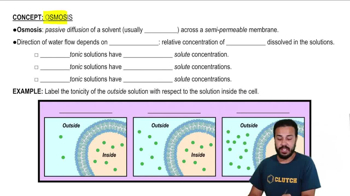
Osmosis

Osmosis is the passive diffusion of water molecules through a selectively permeable membrane from a region of low solute concentration to high solute concentration. It balances solute concentrations on both sides of the membrane without requiring cellular energy.
Recommended video: