
Textbook Question
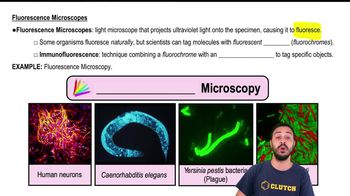
Three-dimensional images of live cells can be produced with:
a. Darkfield microscopy
b. Fluorescence microscopy
c. Transmission electron microscopy
d. Confocal microscopy
e. Phase-contrast microscopy
2
views

 Verified step by step guidance
 02:54
02:54 02:54
02:54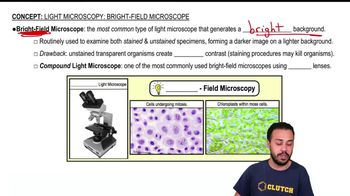 03:46
03:46Three-dimensional images of live cells can be produced with:
a. Darkfield microscopy
b. Fluorescence microscopy
c. Transmission electron microscopy
d. Confocal microscopy
e. Phase-contrast microscopy
The maximum magnification of a compound microscope is (a) ________; that of an electron microscope, (b) ________. The maximum resolution of a compound microscope is (c) ________; that of an electron microscope, (d) ________. One advantage of a scanning electron microscope over a transmission electron microscope is (e) ________.
Which of the following is not a functionally analogous pair of stains?
a. Nigrosin and malachite green
b. Crystal violet and carbolfuchsin
c. Safranin and methylene blue
d. Ethanol-acetone and acid-alcohol
e. All of the above pairs are functionally analogous.
Calculate the total magnification of the nucleus of a cell being observed through a compound light microscope with a 10x ocular lens and an oil immersion lens.
Which type of microscope would be best to use to observe each of the following?
a. A stained bacterial smear
b. Unstained bacterial cells: the cells are small, and no detail is needed
c. Unstained live tissue when it is desirable to see some intracellular detail
d. A sample that emits light when illuminated with ultraviolet light
e. Intracellular detail of a cell that is 1μm long
f. Unstained live cells in which intracellular structures are shown in color
Carbolfuchsin can be used as a simple stain and a negative stain. As a simple stain, the pH is:
a. 2
b. Higher than the negative stain
c. Lower than the negative stain
d. The same as the negative stain