Ch. 11 - Characterizing and Classifying Prokaryotes
Bauman - Microbiology with Diseases by Taxonomy 6th Edition
Bauman6th EditionMicrobiology with Diseases by TaxonomyISBN: 9780134832302Not the one you use?Change textbook
Chapter 11, Problem 4

For each of the following statements that is true, write “true” in the blank. For each statement that is false, write the word(s) that should be substituted for the underlined word(s) to make the statement correct.
__________ Chlamydias have peptidoglycan cell walls.

Verified step by step guidance
1
Recall the structural characteristics of Chlamydias, which are a group of obligate intracellular bacteria.
Understand that peptidoglycan is a key component of most bacterial cell walls, providing rigidity and shape.
Note that Chlamydias are unique because they lack a typical peptidoglycan layer in their cell walls, which is unusual for bacteria.
Therefore, the statement 'Chlamydias have peptidoglycan cell walls' is false.
To correct the statement, replace 'peptidoglycan cell walls' with 'a reduced or absent peptidoglycan layer' or 'an atypical cell wall lacking peptidoglycan'.

Verified video answer for a similar problem:

This video solution was recommended by our tutors as helpful for the problem above.
Video duration:
1m
Was this helpful?

Key Concepts

Here are the essential concepts you must grasp in order to answer the question correctly.

Chlamydias and Their Cell Wall Structure

Chlamydias are a group of obligate intracellular bacteria known for their unique cell wall structure. Unlike typical Gram-negative bacteria, they lack a classical peptidoglycan layer, which is unusual for bacteria. Instead, their cell walls contain a reduced or modified peptidoglycan-like substance, contributing to their distinct biology.
Recommended video:
Guided course
02:59
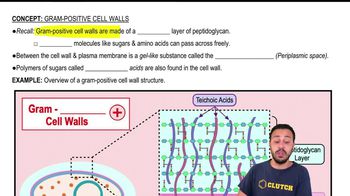
Gram-Positive Cell Walls

Peptidoglycan Composition and Function

Peptidoglycan is a polymer that forms a rigid layer outside the plasma membrane of most bacteria, providing structural support and shape. It is essential for bacterial survival and is the target of many antibiotics. The presence or absence of peptidoglycan is a key factor in bacterial classification and antibiotic susceptibility.
Recommended video:
Guided course
06:04
Functional Groups

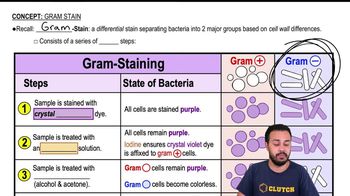
Gram Staining and Bacterial Cell Wall Differences

Gram staining differentiates bacteria based on their cell wall composition, primarily the thickness of peptidoglycan. Gram-positive bacteria have thick peptidoglycan layers, while Gram-negative bacteria have thin layers plus an outer membrane. Chlamydias do not fit neatly into this scheme due to their atypical cell wall lacking typical peptidoglycan.
Recommended video: