Ch. 9 - Biotechnology & DNA Technology
Tortora - Microbiology: An Introduction 14th Edition
Tortora14th EditionMicrobiology: An IntroductionISBN: 9780138200398Not the one you use?Change textbook
Chapter 9, Problem 4

Suppose you want multiple copies of a gene you have synthesized. How would you obtain the necessary copies by cloning? By PCR?

Verified step by step guidance
1
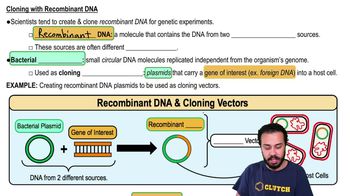
To obtain multiple copies of a gene by cloning, first insert the synthesized gene into a suitable cloning vector, such as a plasmid, using restriction enzymes and DNA ligase to create recombinant DNA.
Next, introduce the recombinant plasmid into a host organism, typically competent bacterial cells, through a process called transformation.
Allow the transformed bacteria to grow on selective media that contains antibiotics, ensuring only bacteria with the plasmid survive and replicate, thereby amplifying the gene of interest.
To obtain multiple copies of the gene by PCR (Polymerase Chain Reaction), design specific primers that flank the gene sequence you want to amplify.
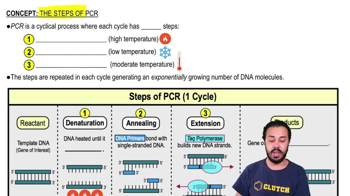
Set up the PCR reaction with the synthesized gene as the template, primers, nucleotides, DNA polymerase, and buffer, then run thermal cycling to denature, anneal primers, and extend new DNA strands, exponentially amplifying the gene.

Verified video answer for a similar problem:

This video solution was recommended by our tutors as helpful for the problem above.
Video duration:
2m
Was this helpful?

Key Concepts

Here are the essential concepts you must grasp in order to answer the question correctly.

Gene Cloning

Gene cloning involves inserting a specific DNA fragment into a vector, such as a plasmid, which is then introduced into a host cell like bacteria. The host replicates, producing multiple copies of the inserted gene. This method allows for the amplification and isolation of large quantities of the gene for further study or use.
Recommended video:
Guided course
03:41
Cloning with Recombinant DNA

Polymerase Chain Reaction (PCR)

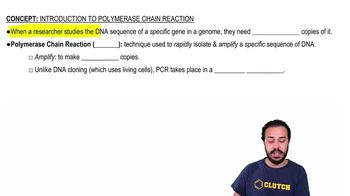
PCR is a laboratory technique used to amplify specific DNA sequences exponentially through repeated cycles of denaturation, annealing of primers, and extension by DNA polymerase. It is a fast and efficient method to generate millions of copies of a gene without the need for living cells.
Recommended video:
Guided course
01:31
Introduction to Polymerase Chain Reaction

Differences Between Cloning and PCR

While both cloning and PCR produce multiple copies of a gene, cloning involves biological replication within host cells and can generate large quantities of DNA with high fidelity, including plasmid vectors. PCR is a cell-free, rapid method ideal for amplifying shorter DNA fragments but may introduce errors and is limited by fragment size.
Recommended video:
Guided course
04:39
The Steps of PCR