Ch. 4 - Functional Anatomy of Prokaryotic and Eukaryotic Cells
Tortora - Microbiology: An Introduction 14th Edition
Tortora14th EditionMicrobiology: An IntroductionISBN: 9780138200398Not the one you use?Change textbook
Chapter 4, Problem 2

Endospore formation is called (a) ________. It is initiated by (b) ________. Formation of a new cell from an endospore is called (c) ________. This process is triggered by (d) ________.

Verified step by step guidance
1
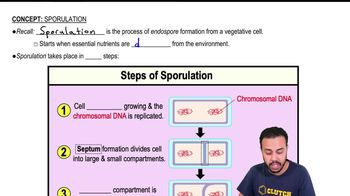
Step 1: Understand that endospore formation is a survival mechanism used by certain bacteria to withstand harsh environmental conditions. The specific term for this process is called 'sporulation'.
Step 2: Identify what initiates sporulation. It is typically triggered by nutrient limitation or environmental stress, which signals the bacterial cell to begin forming an endospore.
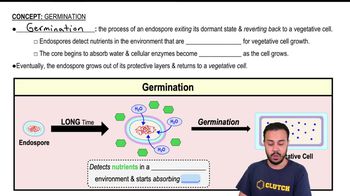
Step 3: Recognize the term for the process by which a new vegetative cell emerges from a mature endospore. This process is called 'germination'.
Step 4: Determine what triggers germination. Germination is usually initiated by favorable environmental conditions, such as the presence of nutrients, moisture, and suitable temperature.
Step 5: Summarize the answers: (a) Sporulation, (b) Nutrient limitation or environmental stress, (c) Germination, (d) Favorable environmental conditions.

Verified video answer for a similar problem:

This video solution was recommended by our tutors as helpful for the problem above.
Video duration:
2m
Was this helpful?

Key Concepts

Here are the essential concepts you must grasp in order to answer the question correctly.

Sporulation

Sporulation is the process of endospore formation in certain bacteria, allowing them to survive harsh conditions. It involves a series of cellular changes leading to the development of a highly resistant, dormant structure called an endospore.
Recommended video:

Initiation of Sporulation

Sporulation is typically initiated by environmental stress, such as nutrient deprivation or unfavorable conditions. These triggers activate genetic pathways that start the formation of the endospore to ensure bacterial survival.
Recommended video:

Germination

Germination is the process by which a dormant endospore returns to its vegetative, active state, forming a new bacterial cell. This process is usually triggered by favorable environmental conditions like the presence of nutrients.
Recommended video:
Related Practice
Textbook Question

Match the structures in column A to their functions in column B.

1
views

Textbook Question

Draw the bacterial shapes listed in (a), (b), and (c). Then draw the shapes in (d), (e), and (f), showing how they are special conditions of a, b, and c, respectively.

a. Spiral

b. Bacillus

c. Coccus

d. Spirochetes

e. Staphylococci

f. Streptobacilli

1
views
Textbook Question

Use the following choices to answer the following question.

a. No change will result; the solution is isotonic.

b. Water will move into the cell.

c. Water will move out of the cell.

d. The cell will undergo osmotic lysis.

e. Sucrose will move into the cell from an area of higher concentration to one of lower concentration.


Which statement best describes what happens when a gram-negative bacterium is placed in distilled water and penicillin?

3
views
Textbook Question

Diagram each of the following flagellar arrangements:

a. Lophotrichous

b. Monotrichous

c. Peritrichous

d. Amphitrichous

e. Polar

Textbook Question

Use the following choices to answer the following question.

a. No change will result; the solution is isotonic.

b. Water will move into the cell.

c. Water will move out of the cell.

d. The cell will undergo osmotic lysis.

e. Sucrose will move into the cell from an area of higher concentration to one of lower concentration.


Which statement best describes what happens when a gram-positive bacterium is placed in distilled water and penicillin?

2
views
Textbook Question

Which of the following is not a distinguishing characteristic of prokaryotic cells?

a. They usually have a single, circular chromosome.

b. They have 70S ribosomes.

c. They have cell walls containing peptidoglycan.

d. Their DNA is not associated with histones.

e. They lack a plasma membrane.

3
views