
Textbook Question
Label each type of flagellar arrangement.
a. __________ <IMAGE> b. __________ <IMAGE>
c. __________ <IMAGE> d. __________ <IMAGE>
2
views

 Verified step by step guidance
 05:59
05:59
 03:45
03:45 03:46
03:46Label each type of flagellar arrangement.
a. __________ <IMAGE> b. __________ <IMAGE>
c. __________ <IMAGE> d. __________ <IMAGE>
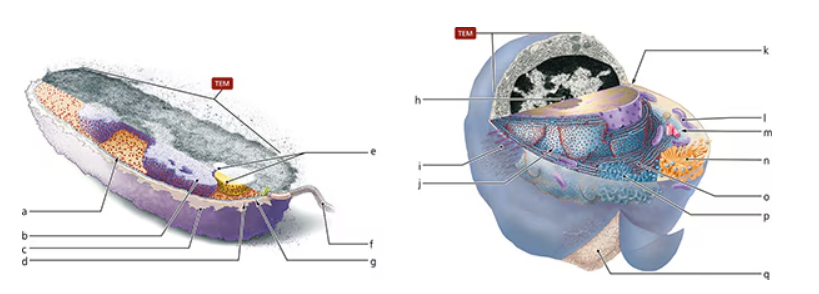
Match the terms with their descriptions following. Only one description is intended for each term.
____ Ribosome
____ Cytoskeleton
____ Centriole
____ Nucleus
____ Mitochondrion
____ Chloroplast
____ ER
____ Golgi body
____ Peroxisome
A. Site of protein synthesis
B. Contains enzymes to neutralize hydrogen peroxide
C. Functions as the transport system within a eukaryotic cell
D. Allows contraction of the cell
E. Site of most DNA in eukaryotes
F. Contains microtubules in "9 + 0" arrangement
G. Light-harvesting organelle
H. Packages large molecules for export from a cell
I. Its internal membranes are sites for ATP production
Sketch, name, and describe three flagellar arrangements in bacteria.
A cell may allow a large or charged chemical to move across the cytoplasmic membrane, down the chemical’s electrical and chemical gradients, in a process called _________ . .
a. active transport
b. facilitated diffusion
c. endocytosis
d. pinocytosis
Describe (or draw) an example of diffusion down a concentration gradient.
Match the structures with their descriptions following. A letter may be used more than once or not at all, and more than one letter may be correct for each blank.
____ Glycocalyx
____ Flagella
____ Axial filaments
____ Cilia
____ Fimbriae
____ Pili
____ Hami
A. Bristlelike projections found in quantities of 100 or more
B. Long whip
C. Responsible for conjugation
D. “Sweet cup” composed of polysaccharides and/or polypeptides
E. Numerous “grappling-hook” projections
F. Responsible for motility of spirochetes
G. Extensions not used for cell motility
H. Made of tubulin in eukaryotes
I. Made of flagellin in bacteria