Ch. 8 - Microbial Genetics
Tortora - Microbiology: An Introduction 14th Edition
Tortora14th EditionMicrobiology: An IntroductionISBN: 9780138200398Not the one you use?Change textbook
Chapter 8, Problem 4

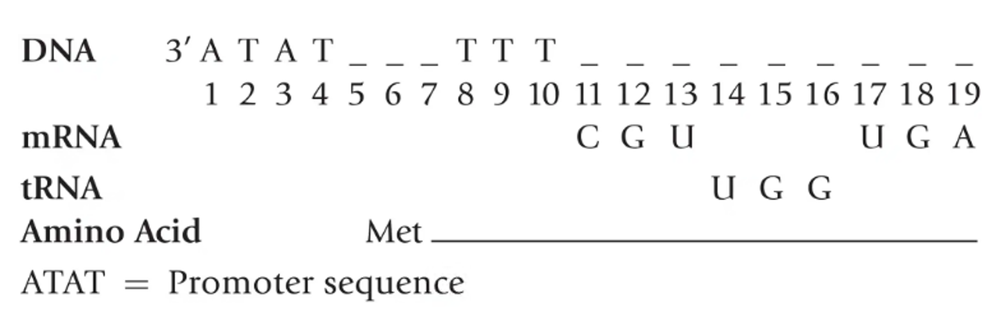
The following is a code for a strand of DNA.
DNA strand with partial nucleotide sequence, corresponding mRNA and tRNA codons, and amino acid sequence starting with Met.
a. Using the genetic code provided in Figure 8.8, fill in the blanks to complete the segment of DNA shown.
b. Fill in the blanks to complete the sequence of amino acids coded for by this strand of DNA.
c. Write the code for the complementary strand of DNA completed in part (a).
d. What would be the effect if C were substituted for T at base 10?
e. What would be the effect if A were substituted for G at base 11?
f. What would be the effect if G were substituted for T at base 14?
g. What would be the effect if C were inserted between bases 9 and 10?
h. How would UV radiation affect this strand of DNA?
i. Identify a nonsense sequence in this strand of DNA.

Verified step by step guidance
1
Step 1: To complete the segment of DNA in part (a), first identify the missing bases by using the base pairing rules: Adenine (A) pairs with Thymine (T), and Cytosine (C) pairs with Guanine (G). Use the given partial sequence and fill in the blanks accordingly.
Step 2: For part (b), transcribe the completed DNA sequence into mRNA by replacing each Thymine (T) with Uracil (U). Then, use the genetic code (Figure 8.8) to translate the mRNA codons (groups of three nucleotides) into their corresponding amino acids, filling in the blanks with the correct amino acid names or abbreviations.
Step 3: In part (c), write the complementary strand of DNA by applying the base pairing rules to the completed strand from part (a). Each base in the original strand pairs with its complement: A with T, T with A, C with G, and G with C.
Step 4: For parts (d), (e), and (f), analyze the effect of each base substitution by determining how the change affects the mRNA codon and the resulting amino acid. Consider whether the substitution causes a silent mutation (no change in amino acid), missense mutation (different amino acid), or nonsense mutation (stop codon).
Step 5: For part (g), evaluate the effect of inserting a base between bases 9 and 10 by considering the impact on the reading frame. This insertion can cause a frameshift mutation, altering all downstream codons and potentially changing the entire amino acid sequence.
Step 6: In part (h), explain how UV radiation can cause thymine dimers in the DNA strand, leading to distortions in the DNA structure and potentially causing mutations during replication.
Step 7: For part (i), identify a nonsense sequence by locating a codon in the mRNA (derived from the DNA strand) that signals a stop codon, which prematurely terminates translation and results in a truncated protein.

Verified video answer for a similar problem:

This video solution was recommended by our tutors as helpful for the problem above.
Video duration:
5m
Was this helpful?

Key Concepts

Here are the essential concepts you must grasp in order to answer the question correctly.

DNA Structure and Base Pairing

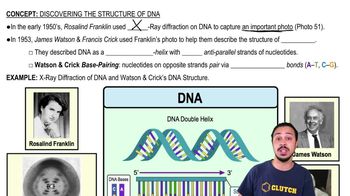
DNA is composed of two strands forming a double helix, with bases pairing specifically: adenine (A) pairs with thymine (T), and cytosine (C) pairs with guanine (G). Understanding complementary base pairing is essential for writing the complementary strand and predicting mutations' effects.
Recommended video:
Guided course
04:41
Discovering the Structure of DNA

Genetic Code and Translation

The genetic code translates nucleotide triplets (codons) in DNA or mRNA into amino acids, the building blocks of proteins. Each codon corresponds to a specific amino acid or a stop signal, so knowing this code is crucial for determining the amino acid sequence from a DNA strand.
Recommended video:

Types and Effects of Mutations

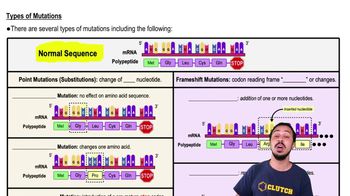
Mutations include substitutions, insertions, and deletions, which can alter the DNA sequence and affect protein synthesis. Some mutations cause silent, missense, or nonsense changes, while insertions or deletions may cause frameshifts, drastically changing the resulting protein's structure and function.
Recommended video:
Guided course
08:44
Types of Mutations