Ch. 7 - Microbial Genetics
Bauman - Microbiology with Diseases by Taxonomy 6th Edition
Bauman6th EditionMicrobiology with Diseases by TaxonomyISBN: 9780134832302Not the one you use?Change textbook
Chapter 7, Problem 7

A daughter DNA molecule is composed of one original strand and one new strand because DNA replication is __________ .

Verified step by step guidance
1
Understand the nature of DNA replication: DNA replication is the process by which a cell duplicates its DNA before cell division.
Recall the three models of DNA replication: conservative, semiconservative, and dispersive.
Identify that in the semiconservative model, each daughter DNA molecule consists of one original (parental) strand and one newly synthesized strand.
Recognize that this model was confirmed by the Meselson-Stahl experiment, which demonstrated the semiconservative nature of DNA replication.
Conclude that the blank in the sentence should be filled with 'semiconservative' to accurately describe the composition of daughter DNA molecules.

Verified video answer for a similar problem:

This video solution was recommended by our tutors as helpful for the problem above.
Video duration:
2m
Was this helpful?

Key Concepts

Here are the essential concepts you must grasp in order to answer the question correctly.

Semiconservative DNA Replication

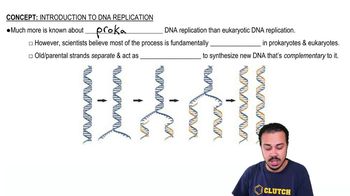
DNA replication is semiconservative, meaning each new DNA molecule consists of one original (parental) strand and one newly synthesized strand. This mechanism ensures genetic continuity by preserving half of the original DNA in each daughter molecule.
Recommended video:
Guided course
03:37
Introduction to DNA Replication

DNA Strand Complementarity

During replication, each original DNA strand serves as a template for the formation of a complementary new strand. Base pairing rules (A with T, and G with C) guide the addition of nucleotides, ensuring accurate copying of genetic information.
Recommended video:
Guided course
05:15
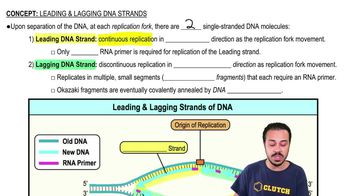
Leading & Lagging DNA Strands

Role of DNA Polymerase

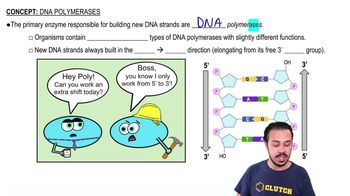
DNA polymerase is the enzyme responsible for synthesizing the new DNA strand by adding nucleotides complementary to the template strand. It also proofreads the new strand to minimize errors during replication.
Recommended video:
Guided course
04:01
DNA Polymerases