Ch. 12 - Adaptive Immunity
Norman-McKay- Microbiology: Basic and Clinical Principles 2nd Edition
Norman-McKay2nd EditionMicrobiology: Basic and Clinical PrinciplesISBN: 9780137661619Not the one you use?Change textbook
Chapter 12, Problem 6

Why are packed red blood cells not tissue typed? Select all that apply.
a. Red blood cells lack MHC II
b. Red blood cells lack MHC I
c. Red blood cells can’t stimulate an immune response
d. Red blood cells aren’t transferred to others
e. Red blood cells don’t make antibodies and therefore do not need to be typed

Verified step by step guidance
1
Step 1: Understand the concept of tissue typing, which is primarily concerned with matching human leukocyte antigens (HLAs) or major histocompatibility complex (MHC) molecules to prevent immune rejection during organ or tissue transplantation.
Step 2: Recall that red blood cells (RBCs) are anucleate cells that do not express MHC class II molecules, which are typically found on antigen-presenting cells and are important for initiating immune responses.
Step 3: Recognize that RBCs do express MHC class I molecules to a very limited extent or not at all, which means they are less likely to be recognized as foreign based on MHC differences.
Step 4: Consider that RBCs do not stimulate an immune response in the same way nucleated cells do because they lack the necessary MHC molecules and antigen-presenting capabilities.
Step 5: Note that RBCs are transfused between individuals, so option d is incorrect, and also that RBCs do not produce antibodies themselves, but this is unrelated to the need for tissue typing.

Verified video answer for a similar problem:

This video solution was recommended by our tutors as helpful for the problem above.
Video duration:
3m
Was this helpful?

Key Concepts

Here are the essential concepts you must grasp in order to answer the question correctly.

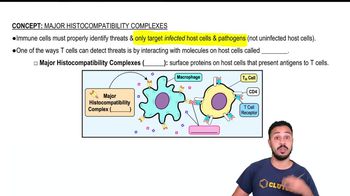
Major Histocompatibility Complex (MHC) on Red Blood Cells

MHC molecules are proteins on cell surfaces that help the immune system recognize self from non-self. Red blood cells lack MHC class II molecules and have minimal or no MHC class I, which reduces their ability to present antigens and trigger immune responses during transfusion.
Recommended video:
Guided course
02:31
Major Histocompatibility Complex Molecules

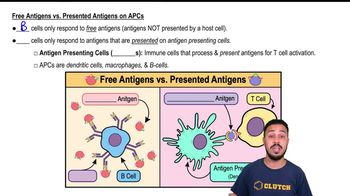
Immune Response and Antigen Presentation

An immune response requires antigen presentation to activate T cells. Since red blood cells do not present antigens via MHC molecules effectively, they cannot stimulate a typical immune response, making tissue typing less critical for transfusions.
Recommended video:
Guided course
04:11
Free Antigens vs. Presented Antigens on APCs

Blood Typing vs. Tissue Typing

Blood typing focuses on identifying blood group antigens (like ABO and Rh) on red blood cells, which are crucial for transfusion compatibility. Tissue typing involves matching MHC antigens for organ transplants, which is unnecessary for red blood cells because they lack these MHC markers.
Recommended video:
Guided course
01:06
Types of Phosphorylation