
Ch. 5 - Microbial Metabolism
Tortora - Microbiology: An Introduction 14th Edition
Tortora14th EditionMicrobiology: An IntroductionISBN: 9780138200398Not the one you use?Change textbook
Chapter 5, Problem 4

Which of the following compounds has the greatest amount of energy for a cell?
a. CO2
b. ATP
c. glucose
d. O2
e. lactic acid

Verified step by step guidance
1
Step 1: Understand that the question is asking which compound contains the greatest amount of usable energy for a cell. This typically refers to the compound's role in cellular metabolism and its energy content available for biological processes.
Step 2: Recall the function and energy content of each compound: CO₂ is a waste product of metabolism and has very low energy content; ATP is the primary energy currency of the cell, providing immediate energy for cellular reactions; glucose is a high-energy molecule that cells break down to produce ATP; O₂ is an electron acceptor in cellular respiration but does not store energy itself; lactic acid is a product of anaerobic metabolism and contains less energy than glucose.
Step 3: Compare the energy content and role of glucose and ATP, since these are the main energy carriers. Glucose stores energy in its chemical bonds and can be metabolized to produce multiple ATP molecules, while ATP stores energy in its phosphate bonds for immediate use.
Step 4: Recognize that glucose, as a carbohydrate, contains more stored chemical energy overall compared to a single ATP molecule, which is more of an energy transfer molecule rather than a long-term energy storage molecule.
Step 5: Conclude that among the options, glucose has the greatest amount of energy stored for a cell, as it can be metabolized to generate multiple ATP molecules, providing a larger energy yield.

Verified video answer for a similar problem:

This video solution was recommended by our tutors as helpful for the problem above.
Video duration:
1m
Was this helpful?

Key Concepts

Here are the essential concepts you must grasp in order to answer the question correctly.

Energy Storage in Biological Molecules

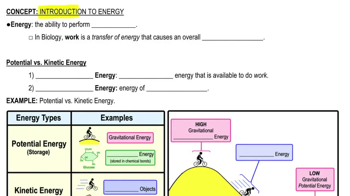
Biological molecules store energy in chemical bonds, with complex organic molecules like glucose containing high-energy bonds that cells can break down to release energy. Understanding which molecules serve as energy reservoirs helps determine their energy content relative to others.
Recommended video:
Guided course
05:04
Introduction to Energy

Role of ATP as an Energy Currency

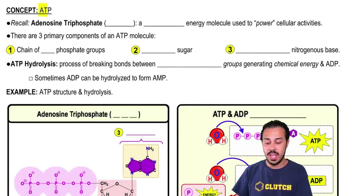
ATP (adenosine triphosphate) is the primary energy carrier in cells, providing readily usable energy through the hydrolysis of its high-energy phosphate bonds. While ATP stores less total energy than glucose, it is crucial for immediate energy transfer in cellular processes.
Recommended video:

Oxidation States and Energy Potential of Molecules

Molecules like CO₂ and O₂ have different oxidation states affecting their energy content; CO₂ is fully oxidized and contains minimal usable energy, whereas O₂ acts as an electron acceptor in respiration. Recognizing oxidation states helps assess the energy available from each compound.
Recommended video:
Guided course
05:04
Introduction to Energy
Related Practice
Textbook Question

An enzyme and substrate are combined. The rate of reaction begins as shown in the following graph. To complete the graph, show the effect of increasing substrate concentration on a constant enzyme concentration. Show the effect of increasing temperature.

1
views
Textbook Question

Which of the following reactions produces the most molecules of ATP during aerobic metabolism?

a. Glucose → Glucose 6-phosphate

b. Phosphoenolpyruvic acid → Pyruvic acid

c. Glucose → Pyruvic acid

d. Acetyl CoA → CO2 + H2O

e. Succinic acid → Fumaric acid

Textbook Question

Define oxidation-reduction, and differentiate the following terms:

a. Aerobic and anaerobic respiration

b. Respiration and fermentation

c. Cyclic and noncyclic photophosphorylation

2
views
Textbook Question

Which of the following processes does not generate ATP?

a. Photophosphorylation

b. The Calvin-Benson cycle

c. Oxidative phosphorylation

d. Substrate-level phosphorylation

e. All of the above generate ATP

1
views
Textbook Question

There are three mechanisms for the phosphorylation of ADP to produce ATP. Write the name of the mechanism that describes each of the reactions in the following table.

5
views
Textbook Question

Which of the following is the best definition of the Krebs cycle?

a. The oxidation of pyruvic acid

b. The way cells produce CO2

c. A series of chemical reactions in which NADH is produced from the oxidation of pyruvic acid

d. A method of producing ATP by phosphorylating ADP

e. A series of chemical reactions in which ATP is produced from the oxidation of pyruvic acid

3
views