Codons are ___________ nucleotides long and are in ___________, which is transcribed from DNA. During ___________, tRNAs serve as adapter molecules to bring ___________ to the ribosome to build a protein. Once the ribosome reaches a(n) ___________ on the mRNA, translation ends.
Ch. 5 - Genetics

Norman-McKay2nd EditionMicrobiology: Basic and Clinical PrinciplesISBN: 9780137661619Not the one you use?Change textbook
Chapter 5, Problem 3
Select the false statement:
a. DNA is made of deoxyribonucleotides.
b. RNA is made of ribonucleotides.
c. RNA is built in a 5' to 3' direction.
d. DNA is built in a 5' to 3' direction.
e. RNA primase builds RNA in transcription.
Verified step by step guidance1
Step 1: Understand the basic composition of DNA and RNA. DNA is composed of deoxyribonucleotides, which are nucleotides containing deoxyribose sugar, while RNA is composed of ribonucleotides, which contain ribose sugar.
Step 2: Recall the directionality of nucleic acid synthesis. Both DNA and RNA strands are synthesized in the 5' to 3' direction, meaning new nucleotides are added to the 3' end of the growing strand.
Step 3: Differentiate between the enzymes involved in DNA replication and RNA synthesis. RNA primase synthesizes short RNA primers during DNA replication, not during transcription.
Step 4: Understand the process of transcription. During transcription, RNA polymerase synthesizes RNA from a DNA template, not RNA primase.
Step 5: Based on these points, identify the false statement by checking which option incorrectly describes the role of RNA primase or any other aspect of nucleic acid structure or synthesis.

Verified video answer for a similar problem:
This video solution was recommended by our tutors as helpful for the problem above.
Video duration:
2mWas this helpful?
Key Concepts
Here are the essential concepts you must grasp in order to answer the question correctly.
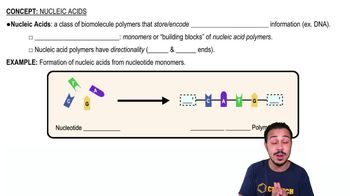
Nucleic Acid Structure
DNA and RNA are nucleic acids composed of nucleotide monomers. DNA contains deoxyribonucleotides, which lack an oxygen atom on the 2' carbon of the sugar, while RNA contains ribonucleotides with a hydroxyl group at the same position. This structural difference affects their stability and function.
Recommended video:
Guided course
Nucleic Acids
Directionality of Nucleic Acid Synthesis
Both DNA and RNA strands are synthesized in the 5' to 3' direction, meaning new nucleotides are added to the 3' hydroxyl end. This directionality is crucial for understanding replication and transcription mechanisms.
Recommended video:
Guided course
Nucleic Acids
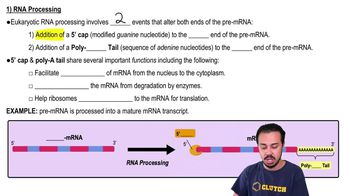
Role of RNA Primase and Transcription
RNA primase synthesizes short RNA primers during DNA replication to initiate DNA synthesis, not during transcription. Transcription is carried out by RNA polymerase, which builds RNA strands complementary to the DNA template.
Recommended video:
Guided course
1) RNA Processing
Related Practice
Textbook Question
1
views
Textbook Question
Match the following:
2
views
Textbook Question
List three features of the genetic code.
3
views
Textbook Question
Indicate the true statements and then correct the false statements so that they are true.
a. DNA is replicated in a 3' to 5' direction.
b. DNA has a parallel arrangement.
c. RNA primase is required on the leading and the lagging strand.
d. DNA ligase forms phosphodiester bonds between Okazaki fragments on the lagging strand.
e. Prokaryotic mRNA requires processing before it is translated.
f. In RNA, A bonds to U.
g. In DNA, C bonds with G.
h. RNA contains deoxyribonucleotides.
3
views
Textbook Question
During ___________ a pilus forms between an F+ and an F−cell and allows for the exchange of genetic material. By the end of the process, the previously F− cell is converted to a(n) ___________ cell.
