Ch. 7 - Microbial Genetics
Bauman - Microbiology with Diseases by Taxonomy 6th Edition
Bauman6th EditionMicrobiology with Diseases by TaxonomyISBN: 9780134832302Not the one you use?Change textbook
Chapter 7, Problem 8

A gene for antibiotic resistance can move horizontally among bacterial cells by __________ , __________ , and __________ .

Verified step by step guidance
1
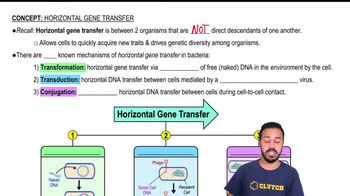
Understand that horizontal gene transfer in bacteria refers to the movement of genetic material between cells, not from parent to offspring.
Identify the three main mechanisms by which bacteria can transfer genes horizontally: transformation, transduction, and conjugation.
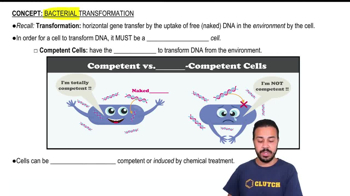
Transformation involves the uptake of free DNA fragments from the environment by a bacterial cell.
Transduction is the process where bacterial DNA is transferred from one bacterium to another via a bacteriophage (a virus that infects bacteria).
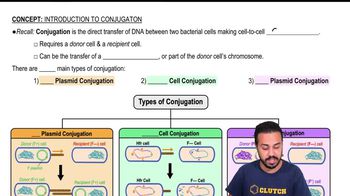
Conjugation requires direct cell-to-cell contact, where a donor bacterium transfers DNA to a recipient through a pilus.

Verified video answer for a similar problem:

This video solution was recommended by our tutors as helpful for the problem above.
Video duration:
2m
Was this helpful?

Key Concepts

Here are the essential concepts you must grasp in order to answer the question correctly.

Horizontal Gene Transfer

Horizontal gene transfer is the movement of genetic material between organisms other than by descent. In bacteria, it allows the spread of traits like antibiotic resistance across different species, enhancing adaptability and survival.
Recommended video:
Guided course
04:42
Horizontal Gene Transfer

Transformation

Transformation is the uptake of free DNA fragments from the environment by a bacterial cell. This process enables bacteria to acquire new genes, such as those conferring antibiotic resistance, directly from lysed cells.
Recommended video:
Guided course
03:06
Bacterial Transformation

Conjugation

Conjugation involves direct transfer of DNA between bacterial cells through a physical connection called a pilus. It often transfers plasmids carrying antibiotic resistance genes, facilitating rapid spread within bacterial populations.
Recommended video:
Guided course
04:21
Introduction to Conjugation