Ch. 7 - Fundamentals of Microbial Growth
Norman-McKay- Microbiology: Basic and Clinical Principles 2nd Edition
Norman-McKay2nd EditionMicrobiology: Basic and Clinical PrinciplesISBN: 9780137661619Not the one you use?Change textbook
Chapter 7, Problem 15

If you were a manufacturer of electronic pacemakers for heart implantation, which agent would you most likely use to treat your product?
a. Ethanol
b. Iodophor
c. Glutaraldehyde
d. Autoclave
e. Ethylene oxide

Verified step by step guidance
1
Step 1: Understand the nature of the product to be treated. Electronic pacemakers are delicate medical devices that contain sensitive electronic components which can be damaged by heat, moisture, or harsh chemicals.
Step 2: Evaluate each sterilization or disinfection method in terms of its compatibility with electronic devices. For example, autoclaving uses high heat and steam, which can damage electronics, so it is generally unsuitable.
Step 3: Consider chemical agents like ethanol, iodophors, and glutaraldehyde. While these are effective disinfectants, they may not provide the level of sterilization required for implanted devices or may leave residues that affect device function.
Step 4: Examine ethylene oxide gas sterilization, which is a low-temperature method that can penetrate packaging and sterilize delicate electronic equipment without causing heat damage.
Step 5: Conclude that the most appropriate agent for sterilizing electronic pacemakers is the one that ensures sterilization without damaging the device, which is typically ethylene oxide gas.

Verified video answer for a similar problem:

This video solution was recommended by our tutors as helpful for the problem above.
Video duration:
2m
Was this helpful?

Key Concepts

Here are the essential concepts you must grasp in order to answer the question correctly.

Sterilization vs. Disinfection

Sterilization is the complete elimination of all microorganisms, including spores, while disinfection reduces or eliminates pathogenic microbes but may not destroy spores. Understanding the difference is crucial when selecting a method for medical devices that enter sterile body sites, like pacemakers.
Recommended video:
Guided course
05:21
Types of Disinfectants

Material Compatibility with Sterilization Methods

Certain sterilization methods can damage sensitive materials. For example, heat-based methods like autoclaving can harm electronic components, so manufacturers must choose sterilization agents or processes that effectively sterilize without compromising device integrity.
Recommended video:
Guided course
05:16
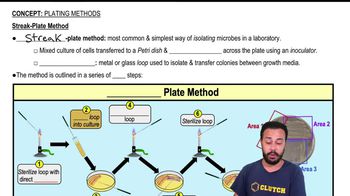
Streak-Plate Method

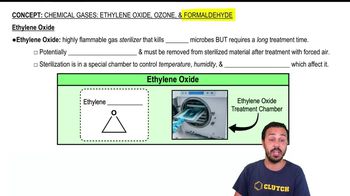
Ethylene Oxide Sterilization

Ethylene oxide is a gaseous sterilant used for heat- and moisture-sensitive medical devices. It penetrates packaging and kills all microorganisms, including spores, without damaging electronics, making it ideal for sterilizing implanted devices like pacemakers.
Recommended video:
Guided course
03:22
Chemical Gases: Ethylene Oxide
Related Practice
Textbook Question

_____________ microbes use oxygen in metabolism, while _____________ do not.

3
views
Textbook Question

You are collecting a sample from a deep wound for analysis by the clinical microbiology lab. Which of the following is not a consideration as you undertake this process?

a. Avoiding the skin as the wound is swabbed

b. Using an anaerobic culture tube

c. Disinfecting the tube before collecting the sample

d. Washing your hands before and after sample collection

e. Using complex media

1
views
Textbook Question

The _____________ is the time needed to kill 90 percent of a given microbial population at a set temperature. The _____________ is the lowest temperature needed to kill all microbes in a sample within 10 minutes.

2
views
Textbook Question

You have a patient who is suffering from a Clostridioides difficile infection. Which of the following would most likely be recommended to decontaminate small heat-stable equipment used for the patient?

a. Autoclave all equipment at 121°C for 15 minutes.

b. Boil equipment for 3 minutes.

c. Place the equipment in a hot-air oven at 121°C for 15 minutes.

d. Treat all equipment with a detergent solution.

e. None of the above.

1
views
Textbook Question

Which of the following is (are) true? Select all that apply.

a. Scalpels are critical equipment.

b. Endoscopes are noncritical equipment.

c. Stethoscopes are noncritical equipment.

d. Anesthesia tubing is semicritical equipment.

e. Critical equipment contacts intact skin.

2
views
Textbook Question

Choose the false statement about turbidity as an enumeration method.

a. It is an indirect enumeration method.

b. It is performed using a spectrophotometer.

c. It must be done using a liquid culture.

d. It differentiates between live and dead cells.

e. It is a rapid enumeration method.

4
views