
Ch. 11 - Characterizing and Classifying Prokaryotes
Bauman - Microbiology with Diseases by Taxonomy 6th Edition
Bauman6th EditionMicrobiology with Diseases by TaxonomyISBN: 9780134832302Not the one you use?Change textbook
Chapter 11, Problem 2

The thick-walled reproductive spores produced in the middle of cyanobacterial filaments are called                  .


a. Akinetes
b. Terminal endospores
c. Metachromatic granules
d. Heterocysts

Verified step by step guidance
1
Understand the types of specialized cells or structures found in cyanobacteria, focusing on their functions and characteristics.
Recall that heterocysts are specialized nitrogen-fixing cells, not reproductive spores, so option (d) can be ruled out.
Recognize that metachromatic granules are storage inclusions, not spores, so option (c) is not correct.
Know that terminal endospores are not typical for cyanobacteria; endospores are more common in certain bacteria like Bacillus species, so option (b) is unlikely.
Identify that akinetes are thick-walled dormant spores formed in the middle of cyanobacterial filaments, serving as reproductive or survival structures, making option (a) the correct answer.

Verified video answer for a similar problem:

This video solution was recommended by our tutors as helpful for the problem above.
Video duration:
2m
Was this helpful?

Key Concepts

Here are the essential concepts you must grasp in order to answer the question correctly.

Akinetes

Akinetes are thick-walled dormant spores formed by some cyanobacteria to survive unfavorable conditions. They develop in the middle of filaments and contain stored nutrients, allowing the organism to endure environmental stress until conditions improve.

Heterocysts

Heterocysts are specialized nitrogen-fixing cells found in some filamentous cyanobacteria. They have thick walls to create an anaerobic environment necessary for nitrogenase activity but are not reproductive spores.

Metachromatic Granules and Endospores

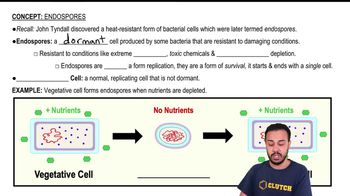
Metachromatic granules are storage inclusions rich in polyphosphate, not spores. Endospores are resistant spores formed by some bacteria like Bacillus, but cyanobacteria do not produce terminal endospores.
Recommended video: