Ch. 5 - Microbial Metabolism
Bauman - Microbiology with Diseases by Taxonomy 6th Edition
Bauman6th EditionMicrobiology with Diseases by TaxonomyISBN: 9780134832302Not the one you use?Change textbook
Chapter 5, Problem 19

The glycolysis pathway is basically _______.
a. catabolic
b. amphibolic
c. anabolic
d. cyclical

Verified step by step guidance
1
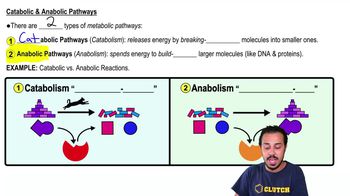
Understand the definitions of the terms: 'catabolic' refers to pathways that break down molecules to release energy; 'anabolic' refers to pathways that build complex molecules from simpler ones, usually requiring energy; 'amphibolic' pathways can function both in breaking down and synthesizing molecules; 'cyclical' pathways involve a series of reactions that regenerate the starting molecule.
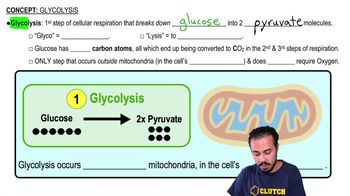
Recall that glycolysis is the process where glucose, a six-carbon sugar, is broken down into two molecules of pyruvate, releasing energy in the form of ATP and NADH.
Since glycolysis involves breaking down glucose into smaller molecules and releasing energy, it fits the definition of a catabolic pathway.
Consider whether glycolysis also functions in biosynthesis (anabolic) or regenerates starting molecules (cyclical). Glycolysis primarily breaks down glucose and does not regenerate its starting molecule, so it is not cyclical or anabolic.
Conclude that the best description of glycolysis among the options is 'catabolic'.

Verified video answer for a similar problem:

This video solution was recommended by our tutors as helpful for the problem above.
Video duration:
2m
Was this helpful?

Key Concepts

Here are the essential concepts you must grasp in order to answer the question correctly.

Glycolysis Pathway

Glycolysis is a metabolic pathway that breaks down glucose into pyruvate, producing ATP and NADH. It occurs in the cytoplasm of cells and is the first step in cellular respiration, providing energy and intermediates for other pathways.
Recommended video:

Catabolic Pathways

Catabolic pathways involve the breakdown of complex molecules into simpler ones, releasing energy stored in chemical bonds. Glycolysis is catabolic because it degrades glucose to extract energy for cellular use.
Recommended video:
Guided course
03:25
Catabolic & Anabolic Pathways

Anabolic and Amphibolic Pathways

Anabolic pathways build complex molecules from simpler ones, consuming energy, while amphibolic pathways serve both catabolic and anabolic roles. Glycolysis is not anabolic or amphibolic because it primarily breaks down glucose rather than synthesizing molecules.
Recommended video:
Guided course
03:25
Catabolic & Anabolic Pathways