Ch. 15 - Microbial Mechanisms of Pathogenicity
Tortora - Microbiology: An Introduction 14th Edition
Tortora14th EditionMicrobiology: An IntroductionISBN: 9780138200398Not the one you use?Change textbook
Chapter 15, Problem 2

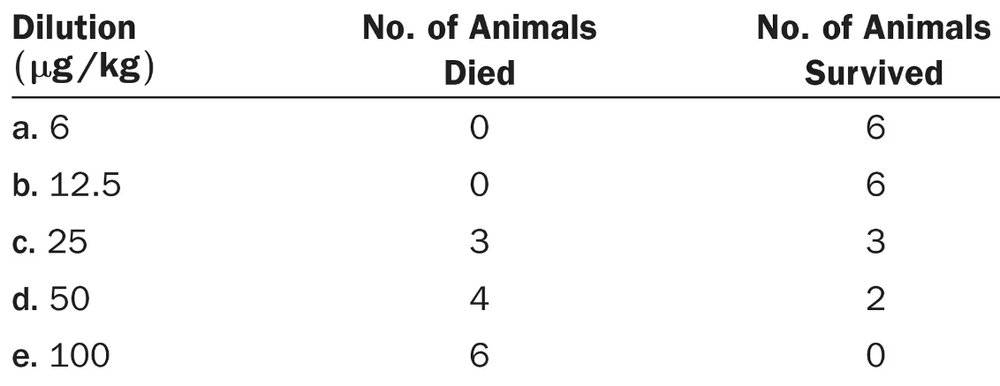
What is the LD₅₀ for the bacterial toxin tested in the following example?

Verified step by step guidance
1
Identify the data provided in the image related to the bacterial toxin's effect on test subjects, such as the doses administered and the corresponding mortality rates.
Organize the data into a dose-response table, listing doses on one side and the percentage or number of deaths observed at each dose on the other.
Use the dose-response data to plot a graph with the dose on the x-axis (usually logarithmic scale) and the percentage mortality on the y-axis.
Determine the dose at which 50% of the test subjects died by either interpolating between data points on the graph or using a mathematical method such as the Reed-Muench or Spearman-Kärber method.
Express the LD₅₀ value as the dose (e.g., in micrograms or milligrams per kilogram) that causes death in 50% of the test population, ensuring units are clearly stated.

Verified video answer for a similar problem:

This video solution was recommended by our tutors as helpful for the problem above.
Video duration:
3m
Was this helpful?

Key Concepts

Here are the essential concepts you must grasp in order to answer the question correctly.

LD₅₀ (Lethal Dose 50%)

LD₅₀ is the dose of a toxin or pathogen that kills 50% of a test population. It is a standard measure of toxicity used to compare the potency of substances. Understanding LD₅₀ helps assess the risk and severity of bacterial toxins.
Recommended video:
Guided course
07:22
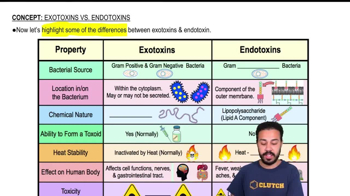
Exotoxins vs. Endotoxin Review

Bacterial Toxins

Bacterial toxins are harmful substances produced by bacteria that can damage host tissues or disrupt physiological functions. They are classified as exotoxins or endotoxins, each with different mechanisms of action and toxicity levels.
Recommended video:
Guided course
03:40
Introduction to Pathogenic Toxins

Dose-Response Relationship

The dose-response relationship describes how the effect of a toxin changes with its concentration or dose. It is essential for determining LD₅₀ by analyzing mortality rates at different toxin doses in experimental models.
Recommended video:
Guided course
05:59
Symbiotic Relationships