
Ch. 11 - Characterizing and Classifying Prokaryotes
Bauman - Microbiology with Diseases by Taxonomy 6th Edition
Bauman6th EditionMicrobiology with Diseases by TaxonomyISBN: 9780134832302Not the one you use?Change textbook
Chapter 11, Problem 3

Name and describe three types of bacteria mentioned in this chapter that “glide.”

Verified step by step guidance
1
Identify the three types of bacteria mentioned in the chapter that exhibit gliding motility. Gliding is a smooth movement of bacteria over surfaces without the use of flagella.
For each type of gliding bacteria, note their taxonomic classification and typical habitats to understand their ecological roles.
Describe the mechanism of gliding motility for each type, as different bacteria may use distinct methods such as secretion of polysaccharide slime, movement of surface proteins, or type IV pili.
Explain the significance of gliding motility in these bacteria, including how it aids in colonization, nutrient acquisition, or biofilm formation.
Summarize the key characteristics of each gliding bacterium, including morphology, motility mechanism, and any unique features highlighted in the chapter.

Verified video answer for a similar problem:

This video solution was recommended by our tutors as helpful for the problem above.
Video duration:
1m
Was this helpful?

Key Concepts

Here are the essential concepts you must grasp in order to answer the question correctly.

Bacterial Gliding Motility

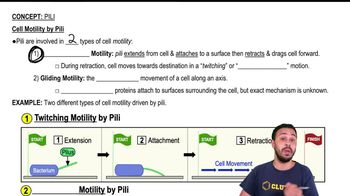
Gliding motility is a type of movement used by some bacteria to move smoothly over surfaces without flagella or pili. It involves the secretion of polysaccharides or the use of surface proteins to propel the cell. This form of motility is important for colonization and biofilm formation.
Recommended video:
Guided course
02:59
Cell Motility by Pili

Types of Gliding Bacteria

Three common types of gliding bacteria include Myxobacteria, Cytophaga, and Flavobacteria. Myxobacteria exhibit social gliding and swarm behavior, Cytophaga glide to degrade complex polysaccharides, and Flavobacteria use gliding to colonize aquatic environments.
Recommended video:
Guided course
02:44
Types of Bacterial Cell Morphology

Mechanisms of Gliding in Different Bacteria

Different bacteria use distinct mechanisms for gliding: Myxobacteria use type IV pili and slime secretion, Cytophaga rely on surface adhesins and motor proteins, while Flavobacteria use a specialized secretion system to move along surfaces. Understanding these mechanisms highlights bacterial diversity.
Recommended video:
Guided course
05:32
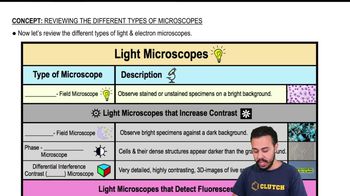
Reviewing the Different Types of Microscopes