Ch. 7 - Microbial Genetics
Bauman - Microbiology with Diseases by Taxonomy 6th Edition
Bauman6th EditionMicrobiology with Diseases by TaxonomyISBN: 9780134832302Not the one you use?Change textbook
Chapter 7, Problem 7

The addition of a ----CH3 to a cytosine nucleotide after DNA replication is called: .
a. Methylation
b. Restriction
c. Transcription
d. Transversion

Verified step by step guidance
1
Understand the question: It asks for the name of the process where a specific chemical group is added to a cytosine nucleotide after DNA replication.
Recall that the addition of a methyl group (–CH3) to cytosine bases in DNA is a common epigenetic modification.
This process is known as methylation, which typically occurs at cytosine residues in CpG dinucleotides and can affect gene expression without changing the DNA sequence.
Review the other options: restriction refers to cutting DNA by restriction enzymes, transcription is the synthesis of RNA from DNA, and transversion is a type of point mutation where a purine is replaced by a pyrimidine or vice versa.
Conclude that the correct term for adding a chemical group to cytosine after DNA replication is methylation.

Verified video answer for a similar problem:

This video solution was recommended by our tutors as helpful for the problem above.
Video duration:
1m
Was this helpful?

Key Concepts

Here are the essential concepts you must grasp in order to answer the question correctly.

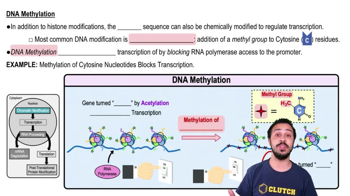
DNA Methylation

DNA methylation is the addition of a methyl group (–CH3) to a cytosine nucleotide, typically at CpG sites, after DNA replication. This epigenetic modification can regulate gene expression without changing the DNA sequence and plays a role in processes like gene silencing and genomic imprinting.
Recommended video:
Guided course
03:39
DNA Methylation

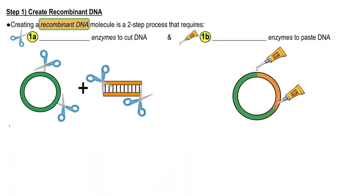
Restriction

Restriction refers to the cutting of DNA at specific sequences by restriction enzymes (restriction endonucleases). It is a natural bacterial defense mechanism against viruses and is widely used in molecular biology for DNA manipulation, but it does not involve modification of cytosine nucleotides.
Recommended video:
Guided course
03:27
1a) Use Restriction Enzymes

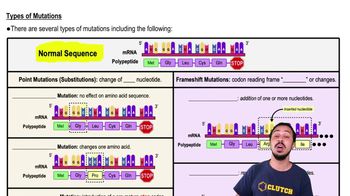
Transversion Mutation

A transversion is a type of point mutation where a purine base is replaced by a pyrimidine base or vice versa (e.g., cytosine replaced by adenine). It changes the DNA sequence but is unrelated to chemical modifications like methylation.
Recommended video:
Guided course
08:44
Types of Mutations