Ch. 10 - Host Microbe Interactions and Pathogenesis
Norman-McKay- Microbiology: Basic and Clinical Principles 2nd Edition
Norman-McKay2nd EditionMicrobiology: Basic and Clinical PrinciplesISBN: 9780137661619Not the one you use?Change textbook
Chapter 10, Problem 1

Assume your patient has a superantigen circulating in their blood. Select the single statement that is most likely to apply to your patient.
a. They are at risk for endotoxic shock.
b. They are not up to date on their vaccinations.
c. They are infected with a Gram-positive microbe.
d. They do not have a fever.
e. They have a viral infection.

Verified step by step guidance
1
Step 1: Understand what a superantigen is. Superantigens are a class of antigens that cause non-specific activation of T-cells, leading to massive cytokine release and an intense immune response.
Step 2: Recall the types of microbes that produce superantigens. Superantigens are typically produced by certain Gram-positive bacteria, such as Staphylococcus aureus and Streptococcus pyogenes.
Step 3: Analyze each option in the context of superantigen activity: (a) Endotoxic shock is caused by endotoxins from Gram-negative bacteria, not superantigens; (b) Vaccination status is unrelated to superantigen presence; (c) Infection with a Gram-positive microbe aligns with superantigen production; (d) Fever is usually present due to cytokine release; (e) Viral infections do not produce superantigens.
Step 4: Conclude that the statement most likely to apply is that the patient is infected with a Gram-positive microbe, as these are the typical producers of superantigens.
Step 5: Remember that superantigens cause a strong immune response, often leading to symptoms like fever and shock, but the key identifying factor is the Gram-positive bacterial source.

Verified video answer for a similar problem:

This video solution was recommended by our tutors as helpful for the problem above.
Video duration:
4m
Was this helpful?

Key Concepts

Here are the essential concepts you must grasp in order to answer the question correctly.

Superantigens and Immune Response

Superantigens are microbial proteins that trigger an excessive activation of T-cells by binding outside the normal antigen recognition site, leading to a massive release of cytokines. This hyperactivation can cause severe systemic effects such as toxic shock syndrome, often associated with certain bacterial infections.
Recommended video:
Guided course
02:57
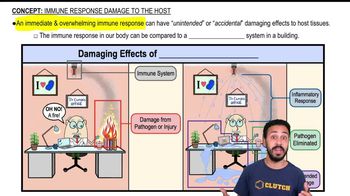
Intro to Immune Response Damage

Gram-Positive Bacteria and Superantigens

Superantigens are commonly produced by Gram-positive bacteria, especially Staphylococcus aureus and Streptococcus pyogenes. These bacteria release toxins that act as superantigens, which can lead to conditions like toxic shock syndrome, distinguishing them from Gram-negative bacteria that produce endotoxins.
Recommended video:
Guided course
02:20
Gram-Positive & Gram-Negative Bacteria

Difference Between Endotoxins and Superantigens

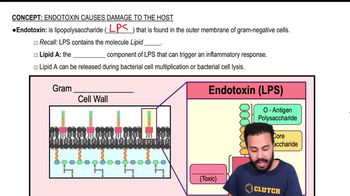
Endotoxins are lipopolysaccharides found in the outer membrane of Gram-negative bacteria and cause endotoxic shock. In contrast, superantigens are exotoxins produced mainly by Gram-positive bacteria and cause toxic shock through immune system overactivation, not by endotoxin mechanisms.
Recommended video: