
Ch. 15 - Microbial Mechanisms of Pathogenicity
Tortora - Microbiology: An Introduction 14th Edition
Tortora14th EditionMicrobiology: An IntroductionISBN: 9780138200398Not the one you use?Change textbook
Chapter 15, Problem 10

Which of the following statements is true?
a. The primary goal of a pathogen is to kill its host.
b. Evolution selects for the most virulent pathogens.
c. A successful pathogen doesn't kill its host before it is transmitted.
d. A successful pathogen never kills its host.

Verified step by step guidance
1
Step 1: Understand the concept of pathogen-host interaction, where the pathogen's goal is to survive and reproduce, often by transmitting to new hosts rather than killing the current host immediately.
Step 2: Analyze option (a): 'The primary goal of a pathogen is to kill its host.' Consider that killing the host too quickly can limit transmission opportunities, so this is generally not true.
Step 3: Analyze option (b): 'Evolution selects for the most virulent pathogens.' Remember that evolution favors traits that maximize transmission, which may not always mean maximum virulence; extremely virulent pathogens may reduce their own spread.
Step 4: Analyze option (c): 'A successful pathogen doesn't kill its host before it is transmitted.' This aligns with the idea that pathogens must keep the host alive long enough to spread to new hosts, making this statement likely true.
Step 5: Analyze option (d): 'A successful pathogen never kills its host.' While some pathogens may not kill their hosts, others can be lethal but still successful if transmission occurs before death; thus, this statement is too absolute to be true.

Verified video answer for a similar problem:

This video solution was recommended by our tutors as helpful for the problem above.
Video duration:
3m
Was this helpful?

Key Concepts

Here are the essential concepts you must grasp in order to answer the question correctly.

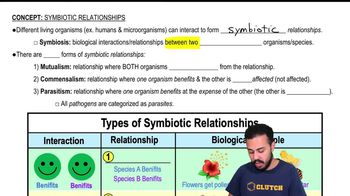
Pathogen-Host Relationship

Pathogens interact with their hosts in ways that balance survival and reproduction. Killing the host too quickly can limit the pathogen's ability to spread, so many pathogens evolve strategies to coexist without immediate host death.
Recommended video:
Guided course
05:59
Symbiotic Relationships

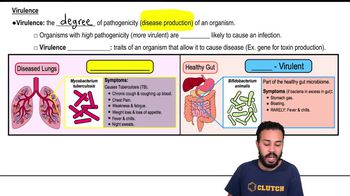
Virulence and Evolution

Virulence refers to the degree of damage a pathogen causes. Evolution tends to favor pathogens that optimize transmission, which may not always mean maximum virulence; overly virulent pathogens risk killing hosts before spreading.
Recommended video:

Transmission and Pathogen Success

A pathogen's success depends on effective transmission to new hosts. Therefore, pathogens that allow their hosts to survive long enough to spread the infection are more likely to persist and evolve.
Recommended video:
Guided course
03:40
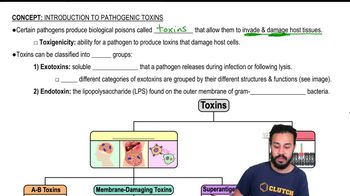
Introduction to Pathogenic Toxins