Ch. 1 - The Microbial World and You
Tortora - Microbiology: An Introduction 14th Edition
Tortora14th EditionMicrobiology: An IntroductionISBN: 9780138200398Not the one you use?Change textbook
Chapter 1, Problem 7

What type of microorganism has a peptidoglycan cell wall, has DNA that is not contained in a nucleus, and has flagella?

Verified step by step guidance
1
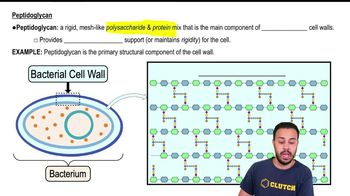
Identify the key characteristics given: the microorganism has a peptidoglycan cell wall, DNA not contained in a nucleus, and possesses flagella.
Recall that peptidoglycan is a major component of bacterial cell walls, which distinguishes bacteria from other microorganisms like archaea, fungi, and protozoa.
Understand that DNA not contained in a nucleus indicates a prokaryotic organism, as eukaryotes have membrane-bound nuclei.
Recognize that flagella are structures used for motility and are present in some bacteria to help them move.
Combine these features to conclude that the microorganism described is a motile bacterium, since bacteria have peptidoglycan cell walls, lack a nucleus, and can have flagella.

Verified video answer for a similar problem:

This video solution was recommended by our tutors as helpful for the problem above.
Video duration:
1m
Was this helpful?

Key Concepts

Here are the essential concepts you must grasp in order to answer the question correctly.

Peptidoglycan Cell Wall

Peptidoglycan is a polymer that forms a rigid structure in the cell walls of certain microorganisms, providing shape and protection. It is a key feature of bacterial cell walls, distinguishing them from archaea and eukaryotes, which lack peptidoglycan.
Recommended video:
Guided course
01:58
Peptidoglycan

Prokaryotic DNA Organization

Prokaryotic cells have DNA that is not enclosed within a nucleus; instead, their genetic material is located in a nucleoid region. This contrasts with eukaryotic cells, where DNA is contained within a membrane-bound nucleus.
Recommended video:
Guided course
05:22
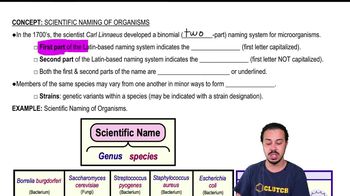
Scientific Naming of Organisms

Flagella in Microorganisms

Flagella are whip-like structures used for locomotion in many microorganisms. In bacteria, flagella are composed of the protein flagellin and enable movement toward favorable environments, playing a role in motility and chemotaxis.
Recommended video:
Guided course
03:48
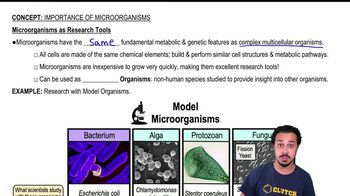
Microorganisms as Research Tools
Related Practice
Textbook Question

Show where airborne microbes ended up in Pasteur’s experiment.

3
views

Textbook Question

Which of the following is a beneficial activity of microorganisms?

a. Some microorganisms are used as food for humans.

b. Some microorganisms use carbon dioxide.

c. Some microorganisms provide nitrogen for plant growth.

d. Some microorganisms are used in sewage treatment processes.

e. all of the above

9
views
Textbook Question

It is possible to purchase the following microorganisms in a retail store. Provide a reason for buying each.

a. Bacillus thuringiensis

b. Saccharomyces

3
views
Textbook Question

Which of the following statements is the best definition of biogenesis?

a. Nonliving matter gives rise to living organisms.

b. Living cells can only arise from preexisting cells.

c. A vital force is necessary for life.

d. Air is necessary for living organisms.

e. Microorganisms can be generated from nonliving matter.

2
views
Textbook Question

It has been said that bacteria are essential for the existence of life on Earth. Which of the following is the essential function performed by bacteria?

a. Control insect populations

b. Directly provide food for humans

c. Decompose organic material and recycle elements

d. Cause disease

e. Produce human hormones such as insulin

6
views
Textbook Question

Which of the following is an example of bioremediation?

a. Application of oil-degrading bacteria to an oil spill

b. Application of bacteria to a crop to prevent frost damage

c. Fixation of gaseous nitrogen into usable nitrogen

d. Production by bacteria of a human protein such as interferon

e. All of the above

2
views