Skip to main content
Macroeconomics
My Course
Learn
Exam Prep
AI Tutor
Study Guides
Flashcards
Explore
Try the app
My Course
Learn
Exam Prep
AI Tutor
Study Guides
Flashcards
Explore
Try the app
Back
Who is Affected by Inflation? definitions
You can tap to flip the card.
Inflation
You can tap to flip the card.
👆
Inflation
A general rise in overall price levels, reducing the purchasing power of money over time.
Track progress
Control buttons has been changed to "navigation" mode.
1/14
Related flashcards
Related practice
Recommended videos
Who is Affected by Inflation? quiz #1
Who is Affected by Inflation?
26 Terms
Who is Affected by Inflation?
11. Unemployment and Inflation
10 problems
Topic
Demand-Pull and Cost-Push Inflation
11. Unemployment and Inflation
10 problems
Topic
12. Unemployment and Inflation
8 topics
11 problems
Chapter
Guided course
05:58
Who is Affected by Inflation?
2
views
Terms in this set (14)
Hide definitions
Inflation
A general rise in overall price levels, reducing the purchasing power of money over time.
Anticipated Inflation
A predictable increase in prices, allowing individuals and businesses to plan and adjust contracts accordingly.
Unanticipated Inflation
An unexpected rise in prices that disrupts financial planning and can harm or benefit different economic groups.
Fixed Income Receiver
An individual whose earnings remain constant, making them vulnerable to rising prices and declining purchasing power.
Purchasing Power
The real value of income or money, measured by the amount of goods and services it can buy.
Nominal Income
The stated amount of money received, not adjusted for changes in price levels.
Real Income
Earnings adjusted for inflation, reflecting the actual buying capacity of income.
Saver
A person who sets aside money, whose savings lose value when prices rise faster than interest earned.
Creditor
A lender who is repaid with money that may have less purchasing power due to unexpected inflation.
Debtor
A borrower who benefits from inflation, as the real value of repayments decreases over time.
Flexible Income Receiver
An individual whose earnings adjust with inflation, often through cost of living adjustments, maintaining purchasing power.
Cost of Living Adjustment
A contract provision that increases income in line with inflation, protecting against loss of purchasing power.
Social Security
A government program providing income, often adjusted for inflation to preserve recipients' purchasing power.
Interest Rate
The percentage charged or earned on money, which may not fully compensate for inflation if not properly anticipated.
 BackBack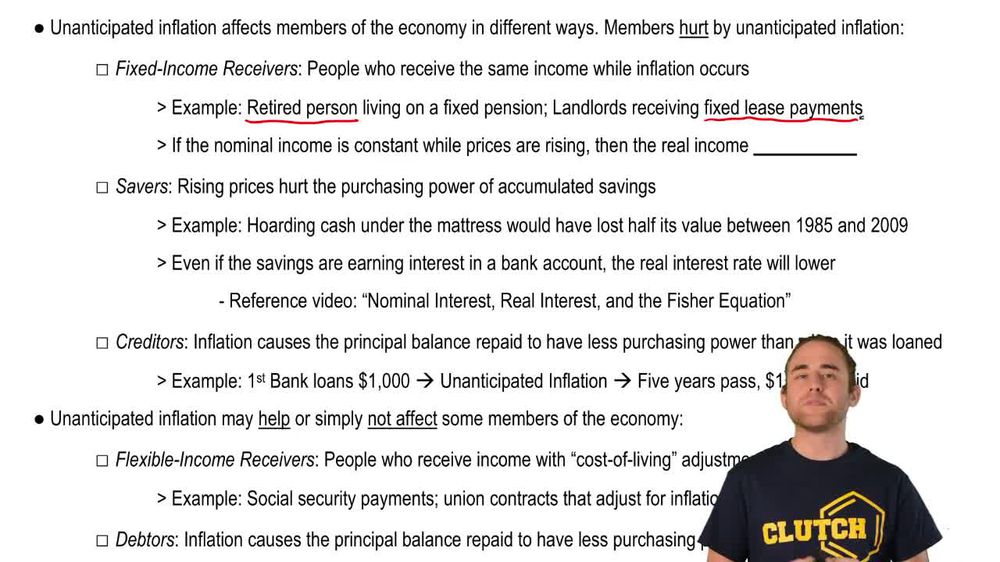
 05:58
05:58