Skip to main content
Macroeconomics
My Course
Learn
Exam Prep
AI Tutor
Study Guides
Flashcards
Explore
Try the app
My Course
Learn
Exam Prep
AI Tutor
Study Guides
Flashcards
Explore
Try the app
Back
The Relationship Between Average Cost and Marginal Cost definitions
You can tap to flip the card.
Marginal Cost
You can tap to flip the card.
👆
Marginal Cost
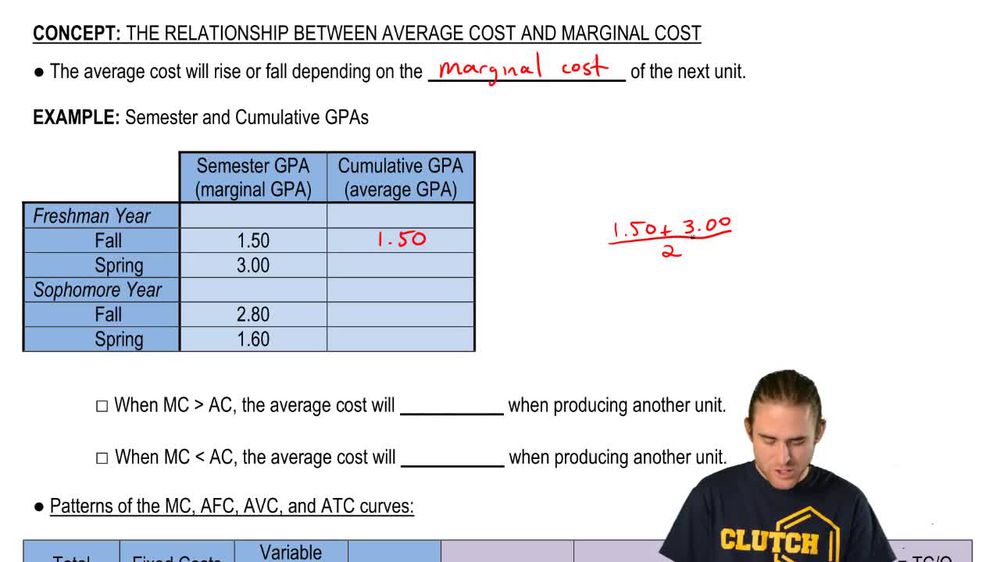
Change in total cost from producing one more unit, acting as the main driver for shifts in average cost.
Track progress
Control buttons has been changed to "navigation" mode.
1/14
Related flashcards
Recommended videos
The Relationship Between Average Cost and Marginal Cost quiz
The Relationship Between Average Cost and Marginal Cost
15 Terms
Guided course
08:56
Patterns of MC, AFC, AVC, and ATC curves
Guided course
06:38
Average Cost and Marginal Cost
Terms in this set (14)
Hide definitions
Marginal Cost
Change in total cost from producing one more unit, acting as the main driver for shifts in average cost.
Average Cost
Total cost divided by output quantity, reflecting the per-unit expense of production.
Average Fixed Cost
Portion of cost that remains constant and is spread over increasing output, always declining as output rises.
Average Variable Cost
Per-unit expense from variable inputs, typically forming a U-shape as output increases.
Average Total Cost
Sum of per-unit fixed and variable expenses, showing a U-shaped pattern as output changes.
Fixed Cost
Expense that does not change with output, such as equipment or rent, impacting only the average fixed cost.
Variable Cost
Expense that rises with increased production, influencing both average variable and total costs.
Production Efficiency
Optimal use of resources to minimize per-unit expenses, highlighted by cost curve behaviors.
Cost Management
Strategic control of expenses to optimize output and profitability, informed by cost relationships.
Diminishing Marginal Productivity
Phenomenon where adding more input eventually yields smaller increases in output, affecting cost curves.
U-Shape
Characteristic pattern of average variable and total cost curves, falling then rising with output.
Aggregate Supply
Total output available in an economy, influenced by underlying cost structures and productivity.
Quantity
Number of units produced, serving as the denominator in average cost calculations.
Total Cost
Sum of all expenses, both fixed and variable, incurred in producing a given output.
 BackBack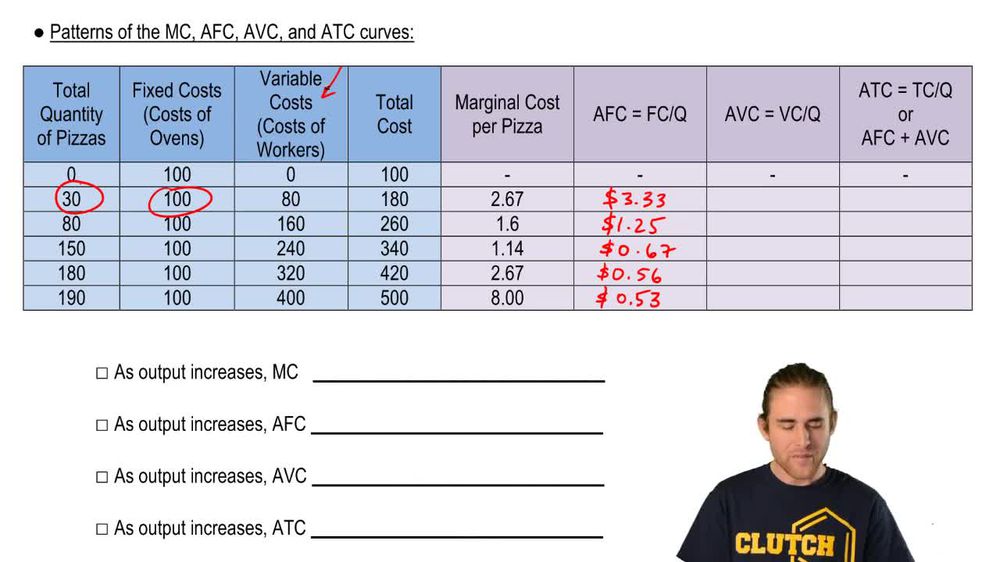
 08:56
08:56