Skip to main content
Macroeconomics
My Course
Learn
Exam Prep
AI Tutor
Study Guides
Flashcards
Explore
Try the app
My Course
Learn
Exam Prep
AI Tutor
Study Guides
Flashcards
Explore
Try the app
Back
The Production Function and Marginal Revenue Product quiz
You can tap to flip the card.
What are the five main factors of production?
You can tap to flip the card.
👆
What are the five main factors of production?
The five main factors of production are land, labor, physical capital, human capital, and entrepreneurship.
Track progress
Control buttons has been changed to "navigation" mode.
1/15
Related flashcards
Recommended videos
The Production Function and Marginal Revenue Product definitions
The Production Function and Marginal Revenue Product
13 Terms
Guided course
02:41
The Factors of Production
1
views
Guided course
02:47
Marginal Revenue Product (Value of the Marginal Product of Labor)
Guided course
10:37
Marginal Revenue Product
1
views
Terms in this set (15)
Hide definitions
What are the five main factors of production?
The five main factors of production are land, labor, physical capital, human capital, and entrepreneurship.
What does the 'land' factor of production include?
Land includes all natural resources, such as forests and oil deposits, not just the physical ground.
Why is labor considered a crucial factor of production?
Labor is crucial because it makes up about 70% of production costs and involves the physical and mental contributions of people.
What is physical capital in the context of production?
Physical capital refers to man-made tools and equipment used in the production process, like factories and machinery.
How does human capital differ from physical capital?
Human capital is the productivity gained from education and training, while physical capital is tangible equipment and tools.
What role does entrepreneurship play in production?
Entrepreneurship organizes, manages, and assembles the other factors of production, bringing ideas to combine resources.
Who demands factors of production in the market?
Firms demand factors of production to produce goods and services, while individuals supply them.
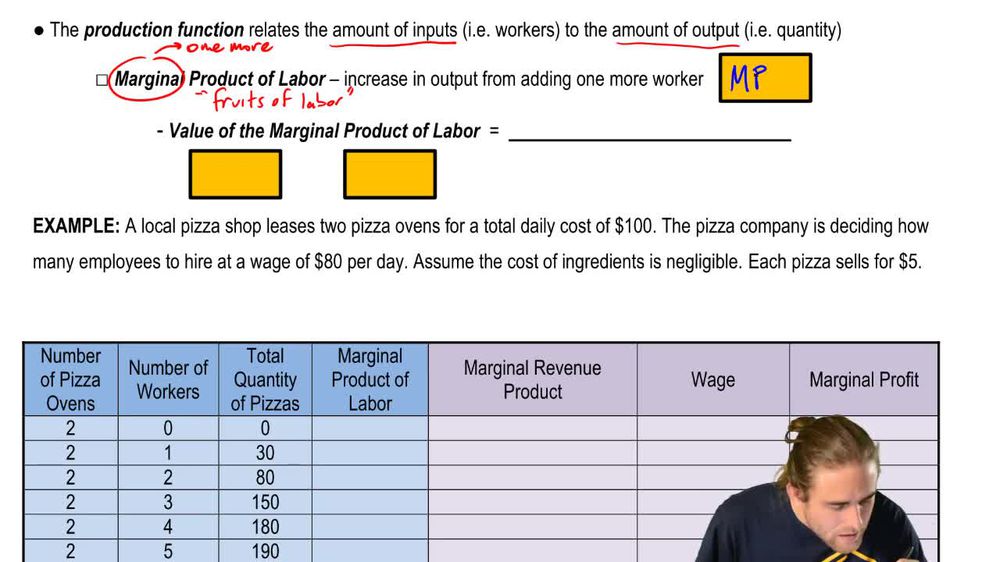
What does the production function relate?
The production function relates the amount of input (like labor) to the amount of output produced.
What is the marginal product of labor (MPL)?
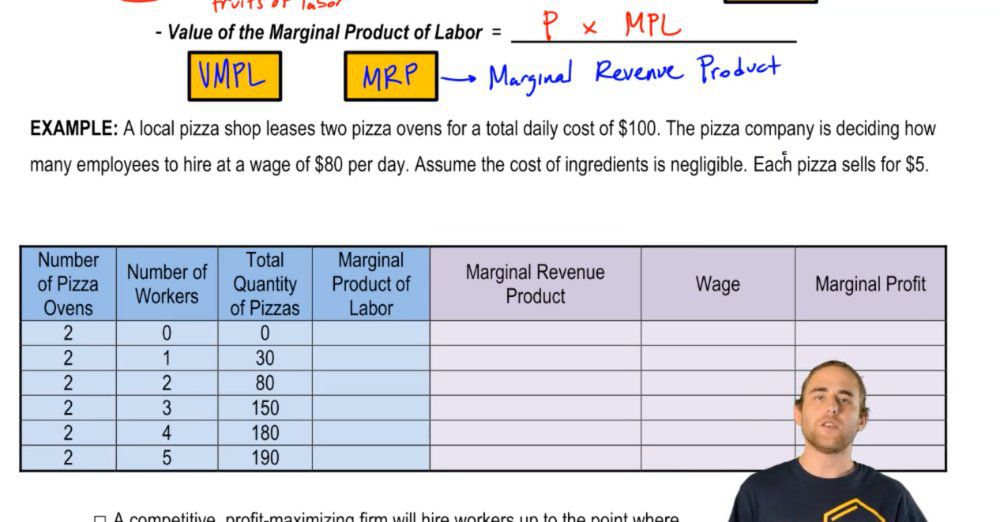
MPL is the additional output produced by hiring one more worker.
How is the marginal product of labor (MPL) calculated?
MPL is calculated by measuring the increase in output when one additional worker is hired.
What does 'marginal' mean in economics?
'Marginal' refers to the effect of adding one more unit, such as one more worker or one more input.
How do you calculate the marginal revenue product (MRP)?
MRP is calculated by multiplying the marginal product of labor (MPL) by the price of the output.
What does the marginal revenue product (MRP) represent?
MRP represents the extra revenue a firm earns from hiring one more worker.
Why do firms use MRP in labor demand decisions?
Firms use MRP to determine how many workers to hire based on the additional revenue each worker generates.
What economic concept is illustrated by diminishing marginal productivity?
Diminishing marginal productivity shows that as more workers are hired, the additional output from each new worker eventually decreases.
 BackBack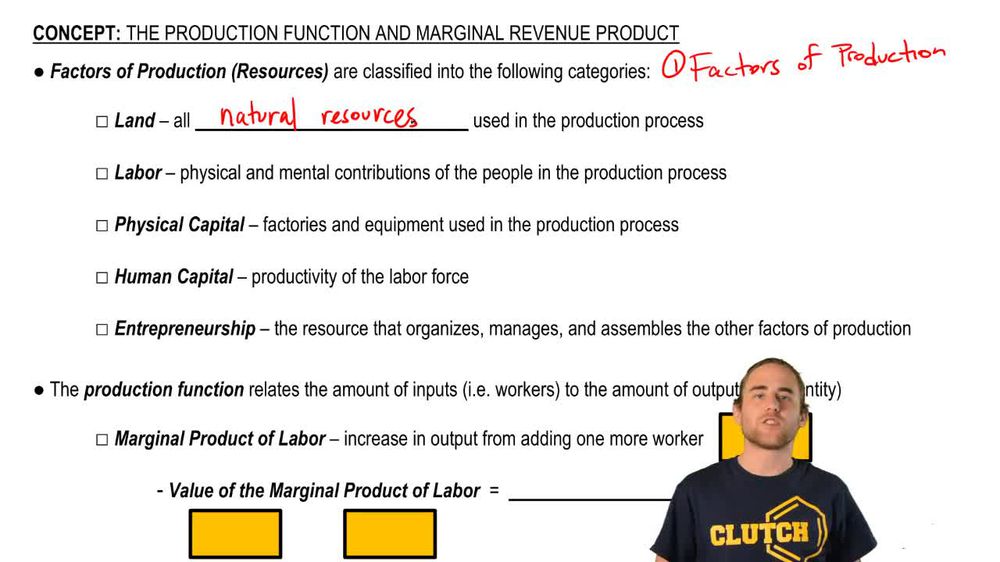
 02:41
02:41