Skip to main content
Macroeconomics
My Course
Learn
Exam Prep
AI Tutor
Study Guides
Flashcards
Explore
Try the app
My Course
Learn
Exam Prep
AI Tutor
Study Guides
Flashcards
Explore
Try the app
Back
The Financial Crisis of 2007-2009 (The Great Recession) definitions
You can tap to flip the card.
Subprime Mortgage
You can tap to flip the card.
👆
Subprime Mortgage
A high-interest loan offered to borrowers with poor credit, often requiring little to no down payment, and carrying a high risk of default.
Track progress
Control buttons has been changed to "navigation" mode.
1/15
Related flashcards
Related practice
Recommended videos
The Financial Crisis of 2007-2009 (The Great Recession) quiz #1
The Financial Crisis of 2007-2009 (The Great Recession)
9 Terms
The Financial Crisis of 2007-2009 (The Great Recession)
17. The Monetary System
10 problems
Topic
History of the US Banking System
17. The Monetary System
10 problems
Topic
18. The Monetary System
7 topics
15 problems
Chapter
Guided course
10:32
Great Recession
4
views
Terms in this set (15)
Hide definitions
Subprime Mortgage
A high-interest loan offered to borrowers with poor credit, often requiring little to no down payment, and carrying a high risk of default.
Mortgage-Backed Security
A financial asset created by bundling various home loans, with returns dependent on homeowners making their mortgage payments.
Investment Bank
A financial institution that trades securities and played a central role in the crisis by holding large amounts of risky mortgage assets.
Commercial Bank
A depository institution insured by the FDIC, primarily involved in traditional banking activities like accepting deposits and making loans.
Securitization
The process of pooling various loans and selling them as tradable financial instruments to investors, spreading risk across markets.
Shadow Banking System
A network of non-bank financial intermediaries engaging in credit activities without traditional regulation or insurance protections.
Insolvency
A financial state where liabilities exceed assets, preventing institutions from meeting their obligations to creditors or depositors.
Troubled Asset Relief Program
A \$700 billion government initiative to purchase distressed assets from banks, aiming to stabilize the financial system during the crisis.
Moral Hazard
A situation where entities take greater risks, believing they will be rescued from negative outcomes, often due to previous bailouts.
Bank Panic
A scenario where widespread fear leads depositors to withdraw funds simultaneously, risking the collapse of financial institutions.
Default
The failure to meet the legal obligations of a loan, often resulting in losses for lenders and investors in related securities.
Too Big to Fail
A concept describing institutions whose collapse would threaten the entire financial system, prompting government intervention.
FDIC Insurance
A federal guarantee protecting bank deposits up to a set limit, designed to prevent depositor losses during bank failures.
Real Estate Market
The sector involving the buying, selling, and valuation of property, whose collapse triggered widespread financial instability.
Credit Loosening
A period when lending standards are relaxed, allowing more borrowers—including high-risk ones—to obtain loans easily.
 BackBack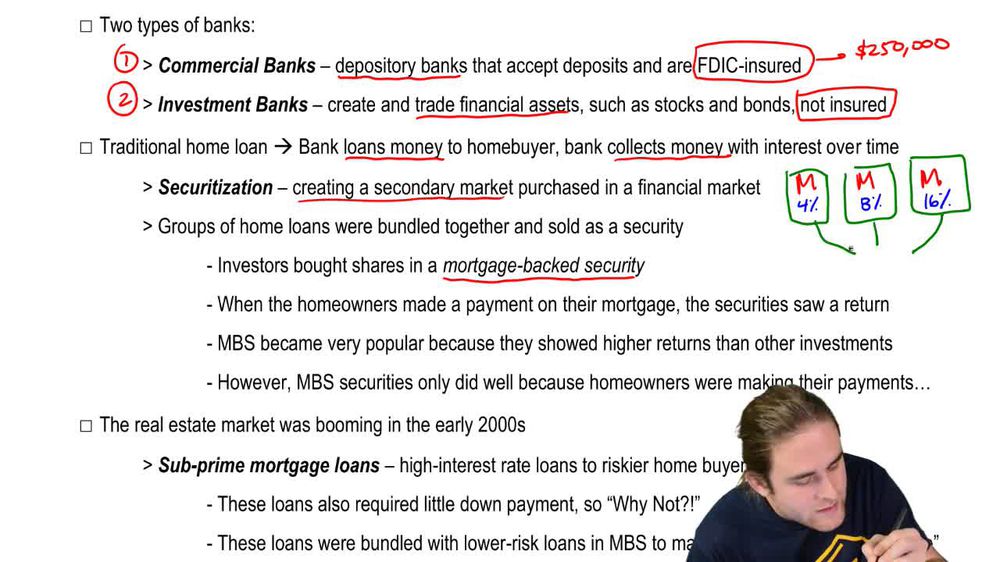
 10:32
10:32