Skip to main content
Macroeconomics
My Course
Learn
Exam Prep
AI Tutor
Study Guides
Flashcards
Explore
Try the app
My Course
Learn
Exam Prep
AI Tutor
Study Guides
Flashcards
Explore
Try the app
Back
The Federal Reserve and the Money Supply definitions
You can tap to flip the card.
Federal Reserve
You can tap to flip the card.
👆
Federal Reserve
Central banking authority in the U.S. responsible for managing the nation's money supply and implementing monetary policy.
Track progress
Control buttons has been changed to "navigation" mode.
1/14
Related flashcards
Related practice
Recommended videos
The Federal Reserve and the Money Supply quiz #1
The Federal Reserve and the Money Supply
10 Terms
The Federal Reserve and the Money Supply
17. The Monetary System
9 problems
Topic
History of the US Banking System
17. The Monetary System
10 problems
Topic
18. The Monetary System
7 topics
15 problems
Chapter
Guided course
05:42
Money Supply:Discount Policy and Required Reserves
3
views
Guided course
06:01
Money Supply:Open Market Operations
3
views
Terms in this set (14)
Hide definitions
Federal Reserve
Central banking authority in the U.S. responsible for managing the nation's money supply and implementing monetary policy.
Monetary Policy
Strategy involving tools to influence the amount of money circulating in the economy, primarily to achieve economic stability.
Discount Policy
Method involving the setting of a specific interest rate for short-term loans to banks, impacting their borrowing behavior.
Discount Rate
Interest percentage charged by the central bank on loans to commercial banks, affecting the cost of borrowing for banks.
Reserve Requirement
Mandated proportion of deposits that banks must keep on hand, limiting the funds available for lending.
Reserve Ratio
Fraction of customer deposits that banks are legally required to hold as reserves rather than loan out.
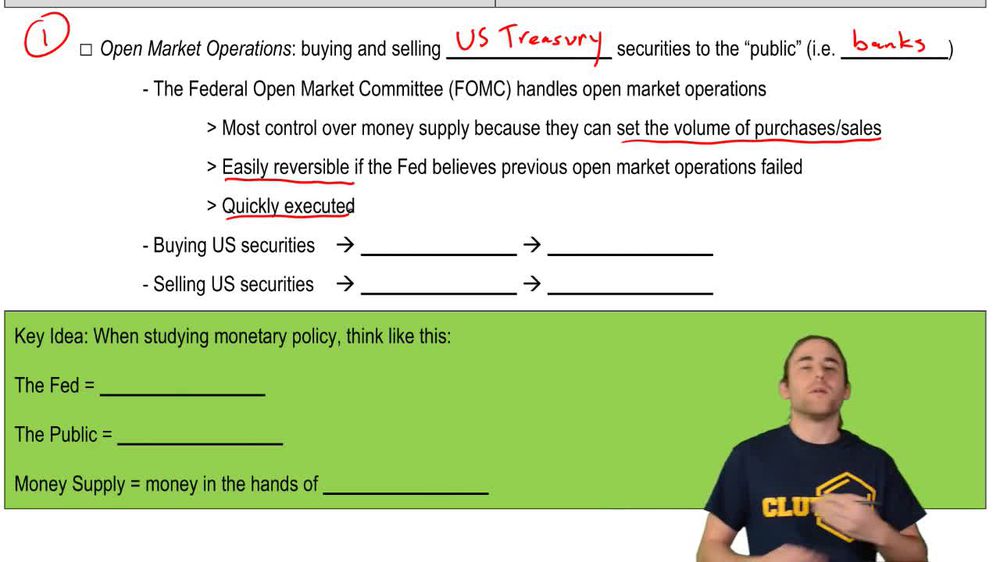
Open Market Operations
Frequent buying and selling of government securities to adjust the volume of money in circulation.
U.S. Treasury Securities
Government-issued financial instruments, such as bonds or bills, used in central bank transactions to influence liquidity.
Federal Open Market Committee
Decision-making group within the central bank responsible for executing open market operations.
Money Supply
Total amount of currency and checkable deposits available to the public for spending and transactions.
Excess Reserves
Bank funds exceeding required reserves, available for lending to customers or other banks.
Required Reserves
Minimum cash or deposit amount banks must hold, as dictated by central bank regulations.
Money Multiplier
Process by which an initial deposit leads to a greater final increase in the total money supply through repeated lending.
Checkable Deposits
Bank account balances that can be accessed on demand, forming a key component of the liquid money supply.
 BackBack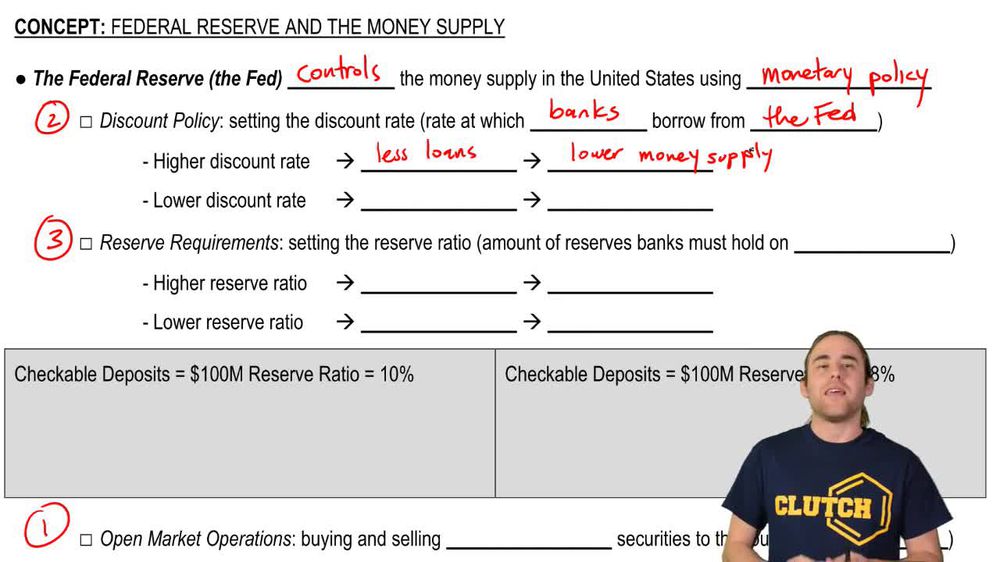
 05:42
05:42