Skip to main content
Macroeconomics
My Course
Learn
Exam Prep
AI Tutor
Study Guides
Flashcards
Explore
Try the app
My Course
Learn
Exam Prep
AI Tutor
Study Guides
Flashcards
Explore
Try the app
Back
The Bretton Woods System quiz
You can tap to flip the card.
What was the main feature of the Bretton Woods system regarding exchange rates?
You can tap to flip the card.
👆
What was the main feature of the Bretton Woods system regarding exchange rates?
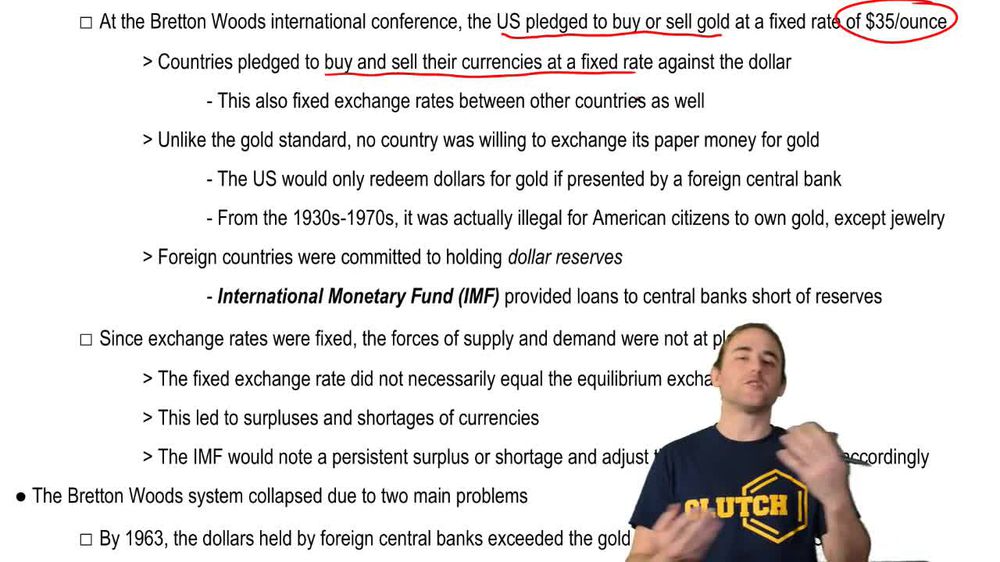
It established a fixed-exchange-rate system where currencies were pegged to the US dollar, which was convertible to gold at \$35 per ounce.
Track progress
Control buttons has been changed to "navigation" mode.
1/15
Related flashcards
Related practice
Recommended videos
The Bretton Woods System definitions
The Bretton Woods System
15 Terms
22. Balance of Payments
5 topics
15 problems
Chapter
Guided course
02:53
Bretton Woods System: Collapse
Guided course
04:04
Bretton Woods System: Introduction
Terms in this set (15)
Hide definitions
What was the main feature of the Bretton Woods system regarding exchange rates?
It established a fixed-exchange-rate system where currencies were pegged to the US dollar, which was convertible to gold at \$35 per ounce.
Why is the system called 'Bretton Woods'?
It is named after the Bretton Woods conference held in New Hampshire, where the system was created.
Who could redeem US dollars for gold under the Bretton Woods system?
Only foreign central banks could redeem US dollars for gold, not regular citizens.
What role did the International Monetary Fund (IMF) play in the Bretton Woods system?
The IMF provided loans to central banks that were short of dollar reserves to help manage currency surpluses or shortages.
How did countries maintain their currency's value in the Bretton Woods system?
Countries pledged to buy and sell their currencies at a fixed rate to the US dollar, maintaining fixed exchange rates.
What was illegal for American citizens during the Bretton Woods era?
It was illegal for American citizens to own gold as an investment, except for jewelry or rare coins.
How did the Bretton Woods system differ from the gold standard regarding gold convertibility?
Unlike the gold standard, only the US dollar was convertible to gold, and only by foreign central banks.
What economic problem could arise from fixed exchange rates not matching equilibrium?
Fixed exchange rates could lead to shortages or surpluses of currencies if not set at equilibrium.
What happened when the dollar reserves held by foreign central banks exceeded US gold reserves?
It undermined the credibility of the system, as the US could not back all dollar reserves with gold.
Why did some countries resist revaluing their undervalued currencies?
They wanted to protect their exports, as revaluing would make exports more expensive and hurt sales overseas.
What was the consequence of countries refusing to revalue their currencies?
It led to shortages, governments printing money, and inflation.
What event marked the collapse of the Bretton Woods system?
In 1971, President Nixon ended the US commitment to redeem dollars for gold, and by 1973 the system was abandoned.
What system replaced Bretton Woods after its collapse?
The managed float system replaced Bretton Woods, where supply and demand primarily determine exchange rates.
How do governments intervene in the managed float system?
Governments may buy or sell their own currency to manage exchange rates if needed.
What was the main reason the Bretton Woods system became difficult to maintain?
Controlling fixed exchange rates became too difficult due to imbalances and lack of gold to back dollar reserves.
 BackBack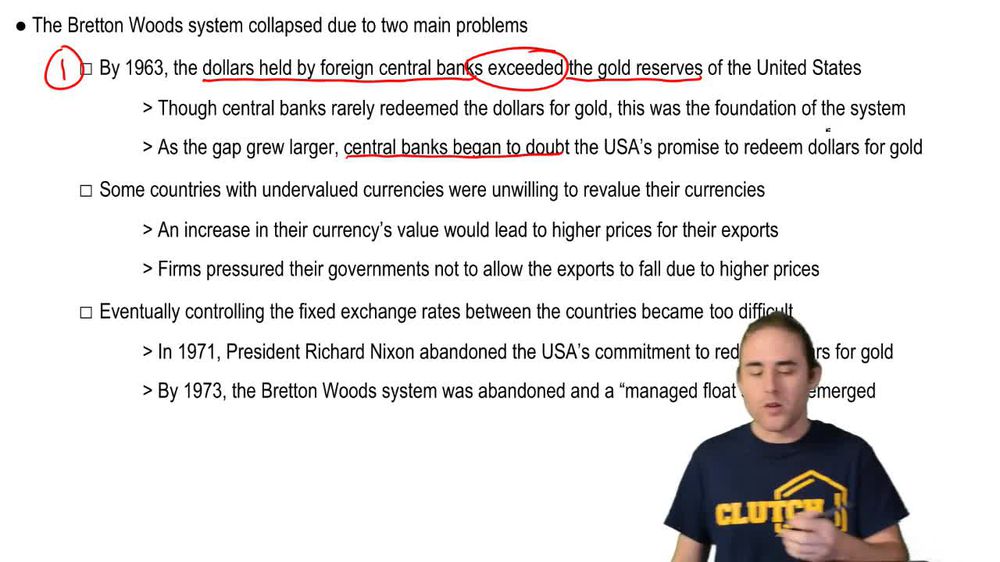
 02:53
02:53