Skip to main content
Macroeconomics
My Course
Learn
Exam Prep
AI Tutor
Study Guides
Flashcards
Explore
Try the app
My Course
Learn
Exam Prep
AI Tutor
Study Guides
Flashcards
Explore
Try the app
Back
The Basics of Supply definitions
You can tap to flip the card.
Supply
You can tap to flip the card.
👆
Supply
Represents the seller side of the market, focusing on the amount producers are willing and able to offer at various prices.
Track progress
Control buttons has been changed to "navigation" mode.
1/12
Related flashcards
Related practice
Recommended videos
The Basics of Supply quiz
The Basics of Supply
15 Terms
The Basics of Supply
3. Supply and Demand
10 problems
Topic
Individual Supply and Market Supply
3. Supply and Demand
10 problems
Topic
3. Supply and Demand - Part 1 of 2
11 topics
15 problems
Chapter
3. Supply and Demand - Part 2 of 2
1 topic
3 problems
Chapter
02:43
The Basics of Supply
3
views
Terms in this set (12)
Hide definitions
Supply
Represents the seller side of the market, focusing on the amount producers are willing and able to offer at various prices.
Quantity Supplied
Refers to the specific amount of a good producers are willing to offer at a particular price point.
Law of Supply
Describes the direct relationship where higher prices lead to greater amounts offered by sellers, and vice versa.
Supply Curve
A graphical representation showing an upward slope, indicating higher prices result in more goods offered.
Supply Schedule
A table listing various prices alongside the corresponding amounts sellers are willing to offer.
Producer
An individual or entity responsible for offering goods or services in the market.
Seller
A market participant who provides goods or services in exchange for payment.
Price
The monetary value assigned to a good or service, influencing the amount offered by sellers.
Market
A setting where buyers and sellers interact to exchange goods, services, or resources.
Demand Curve
A graphical line, typically sloping downward, contrasting with the upward trend of the supply curve.
Determinants
Factors that can cause the amount offered by sellers to shift, to be discussed in further lessons.
Consumer
A participant on the opposite side of the market, focusing on purchasing rather than offering goods.
 BackBack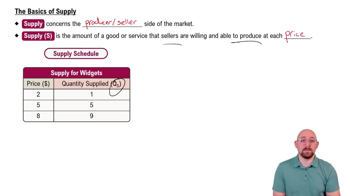
 02:43
02:43