Skip to main content
Macroeconomics
My Course
Learn
Exam Prep
AI Tutor
Study Guides
Flashcards
Explore
Try the app
My Course
Learn
Exam Prep
AI Tutor
Study Guides
Flashcards
Explore
Try the app
Back
The Basics of Demand definitions
You can tap to flip the card.
Demand
You can tap to flip the card.
👆
Demand
Represents the total amount consumers are willing and able to buy at various prices, shown as a curve or schedule.
Track progress
Control buttons has been changed to "navigation" mode.
1/12
Related flashcards
Related practice
Recommended videos
The Basics of Demand quiz #1
The Basics of Demand
10 Terms
The Basics of Demand
3. Supply and Demand
10 problems
Topic
Individual Demand and Market Demand
3. Supply and Demand
10 problems
Topic
3. Supply and Demand - Part 1 of 2
11 topics
15 problems
Chapter
3. Supply and Demand - Part 2 of 2
1 topic
3 problems
Chapter
06:02
The Basics of Demand
Terms in this set (12)
Hide definitions
Demand
Represents the total amount consumers are willing and able to buy at various prices, shown as a curve or schedule.
Quantity Demanded
Refers to the specific amount consumers would purchase at a particular price, represented by a single point.
Demand Schedule
A table listing different prices and the corresponding amounts consumers would buy at each price.
Demand Curve
A graphical representation showing the relationship between price and the amount consumers would buy at each price.
Law of Demand
States that as price rises, the amount consumers buy falls, and as price falls, the amount rises.
Price-Quantity Graph
A chart with price on the vertical axis and amount on the horizontal axis, used to plot consumer behavior.
Substitution Effect
Explains how consumers switch to alternatives when a product's price increases, reducing the amount bought.
Income Effect
Describes how a price change alters consumers' purchasing power, affecting the amount they buy.
Perfectly Competitive Market
A setting where many buyers and sellers interact, and no single participant can influence the price.
Widget
A generic, imaginary product used in examples to illustrate economic concepts without real-world bias.
Abbreviation
A shortened form, such as 'D' for demand and 'Qd' for the amount bought at a specific price.
Downward Slope
Describes the typical shape of the curve showing that as price decreases, the amount bought increases.
 BackBack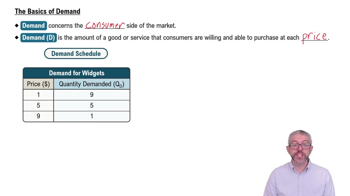
 06:02
06:02