Back

Supply and Demand Together: Equilibrium, Shortage, and Surplus definitions

Control buttons has been changed to "navigation" mode.
1/15
  • Equilibrium

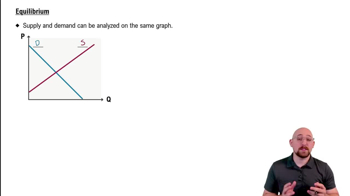
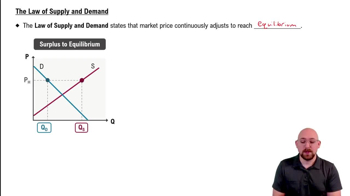
    The unique point where market forces balance, resulting in quantity demanded matching quantity supplied.
  • Demand Curve

    A downward-sloping line on a graph showing the relationship between price and quantity consumers desire.
  • Supply Curve

    An upward-sloping line on a graph representing how much producers are willing to offer at various prices.
  • Equilibrium Price

    The specific value at which buyers and sellers agree, ensuring no persistent shortages or surpluses.
  • Equilibrium Quantity

    The exact amount exchanged in a market when both buyers’ and sellers’ plans align perfectly.
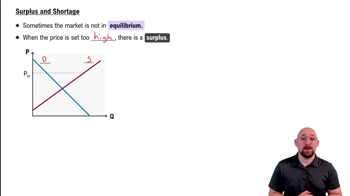
  • Surplus

    A market condition where available goods exceed what buyers want, often leading to price reductions.
  • Shortage

    A situation where consumer desire outpaces what is available, typically causing prices to rise.
  • Excess Supply

    The gap created when more goods are produced than consumers are willing to purchase at a given price.
  • Excess Demand

    The difference arising when buyers seek more goods than are available at a certain price.
  • Market Price

    The current value at which goods are traded, influenced by both consumer and producer behavior.
  • Law of Supply and Demand

    A principle stating that prices adjust automatically to eliminate shortages and surpluses, moving toward balance.
  • Price Adjustment

    The process by which values change in response to imbalances, guiding the market toward equilibrium.
  • Intersection Point

    The spot on a graph where the supply and demand lines meet, indicating market balance.
  • P*

    A symbol denoting the value at which market balance is achieved, with no persistent excess or lack.
  • Q*

    A symbol representing the amount exchanged when the market is balanced, with no ongoing surplus or shortage.