Skip to main content
Macroeconomics
My Course
Learn
Exam Prep
AI Tutor
Study Guides
Flashcards
Explore
Try the app
My Course
Learn
Exam Prep
AI Tutor
Study Guides
Flashcards
Explore
Try the app
Back
Stocks, Bonds, and Mutual Funds definitions
You can tap to flip the card.
Bond
You can tap to flip the card.
👆
Bond
A financial security representing a promise to repay a fixed amount, including principal and interest, at a specified maturity date.
Track progress
Control buttons has been changed to "navigation" mode.
1/15
Related flashcards
Related practice
Recommended videos
Stocks, Bonds, and Mutual Funds quiz
Stocks, Bonds, and Mutual Funds
15 Terms
Stocks, Bonds, and Mutual Funds
13. The Financial System
10 problems
Topic
Risk and Insurance
13. The Financial System
10 problems
Topic
14. The Financial System - Part 1 of 2
8 topics
15 problems
Chapter
13. The Financial System - Part 2 of 2
1 topic
3 problems
Chapter
Guided course
02:47
Mutual Fund Definitions
1
views
02:11
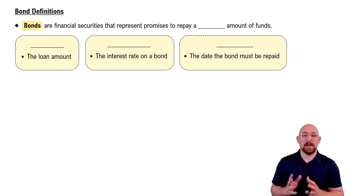
Bond Definitions
Guided course
02:52
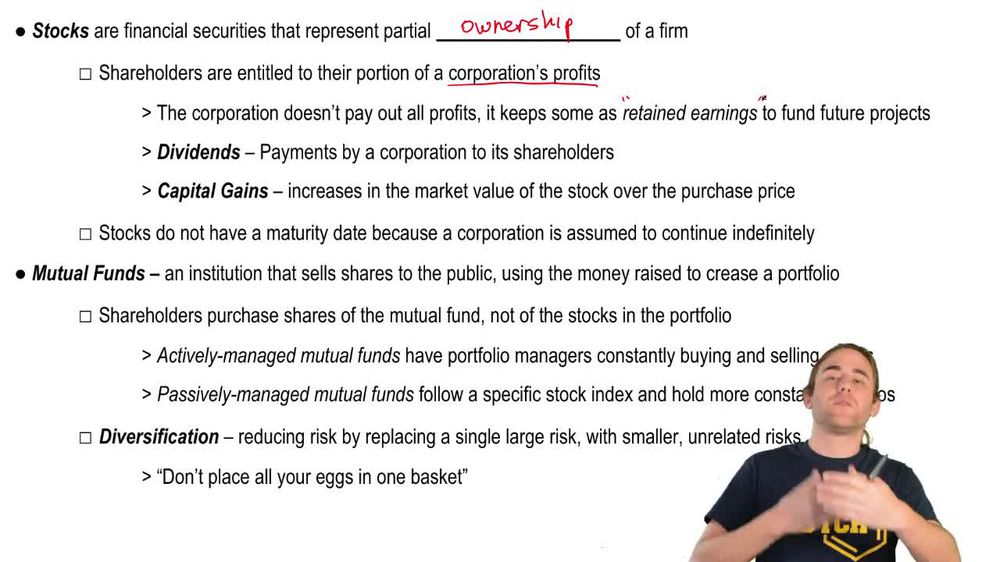
Stock Definitions
2
views
Terms in this set (15)
Hide definitions
Bond
A financial security representing a promise to repay a fixed amount, including principal and interest, at a specified maturity date.
Principal
The original loan amount invested or borrowed, which is repaid to the investor at the end of a bond's term.
Coupon Rate
The fixed interest rate paid to a bondholder, determining the periodic income received from the bond.
Maturity Date
The specific date when the issuer of a bond must repay the principal to the investor.
Bankruptcy
A legal process where a company cannot meet its debt obligations, affecting the order in which investors are repaid.
Stock
A share of ownership in a company, entitling the holder to a portion of profits and potential capital gains.
Shareholder
An individual or entity owning part of a company and entitled to a share of its profits.
Dividend
A payment made by a corporation to its shareholders, distributing a portion of its profits.
Capital Gain
The profit realized from selling a stock at a higher price than its purchase price.
Retained Earnings
Profits kept by a company to fund future projects instead of being distributed to shareholders.
Mutual Fund
An investment vehicle pooling money from many investors to buy a diversified portfolio of assets.
Diversification
A risk-reduction strategy involving investment in a variety of assets to avoid large losses from any single investment.
Portfolio Manager
A professional responsible for selecting and managing the assets within a mutual fund.
Actively Managed Fund
A mutual fund where the manager frequently buys and sells assets to outperform the market.
Passively Managed Fund
A mutual fund designed to replicate the performance of a specific market index with minimal trading.
 BackBack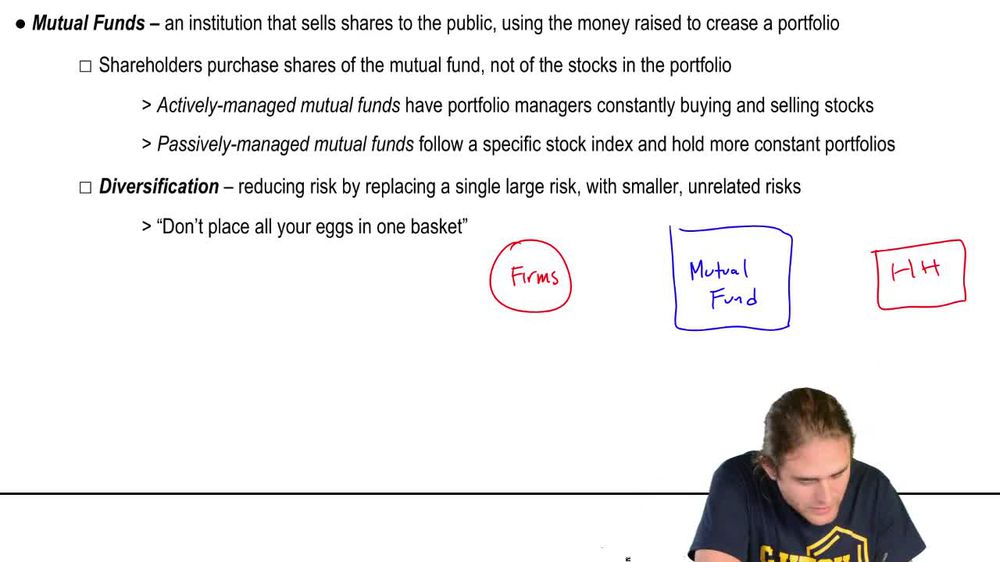
 02:47
02:47